

KAZAKHSTAN · TEXTILES & MAKING
Kazakh Embroidery: Stitches, History and Style
In this story
How a hook makes a lineWhat survivesFrom the yurt wall to the faceWhen the thread starts drawing
This week we’re delving into Kazakh embroidery, namely Keste, tuskiiz and the head covering kimeshek – so lets get into it.
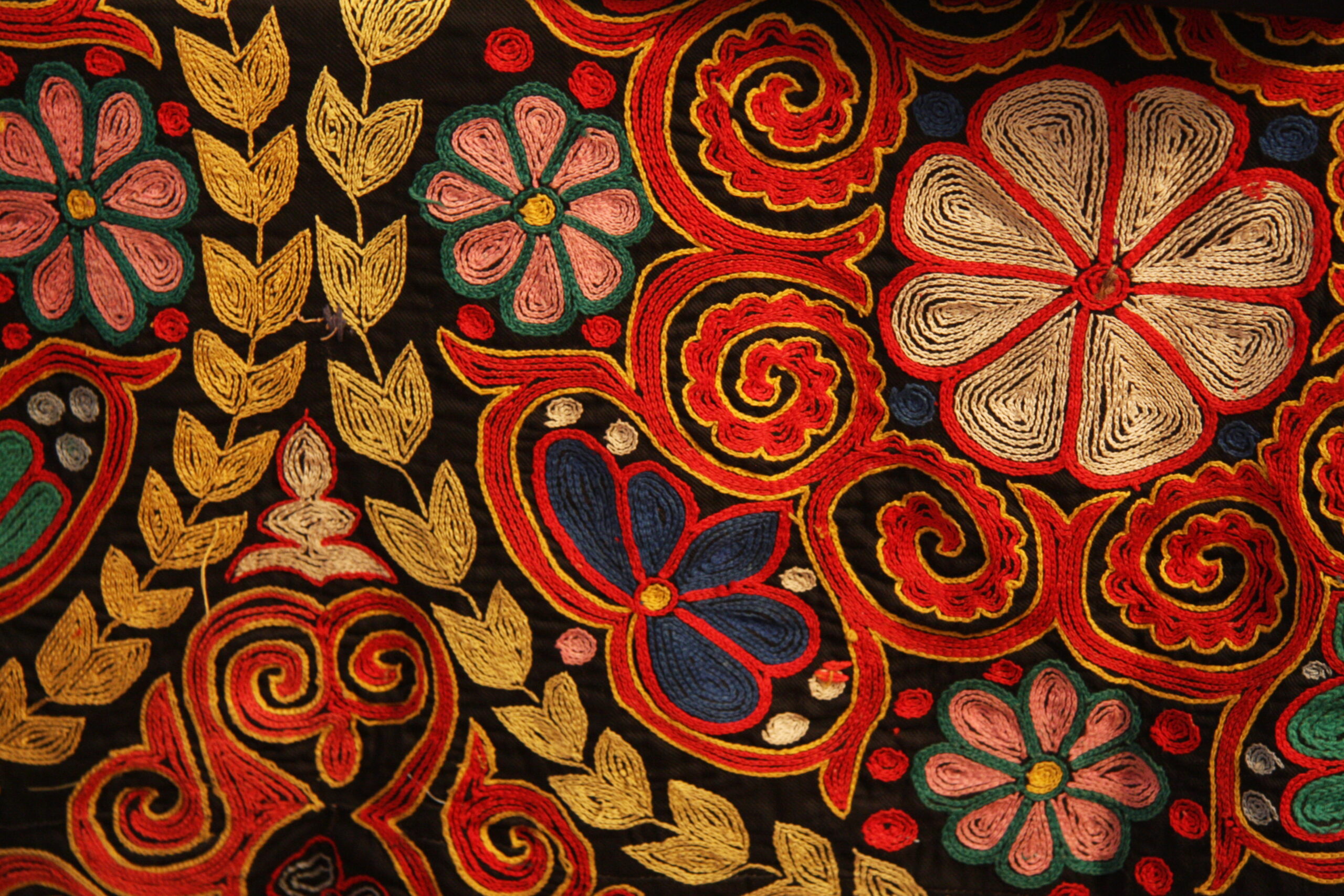
Mark Heard’s photograph of a Kazakh rug, is a great starting point. If you look closely at the banner at the top. You can follow one loop into the next and watch the line curl around a shape. Step back and the loops disappear into the pattern. Come closer and you can see how the pattern was built.
I like that change in scale. It’s easy to see a carpet as one big design and miss the hundreds of small decisions that give it its shape.
How a hook makes a line
Keste is Kazakh hand embroidery. Makers have worked with needles and hooks on fabrics including cotton, silk, velvet and felt. The choice of tool changes what the thread can do. In biz keste, a fine hook draws a loop up through stretched fabric. The next loop passes through the previous one, and the loops link into a chain. That chain can follow a curve, trace an outline or build up an area of colour in closely worked rows (Kargabekova, n.d.; Bekova, 2018).
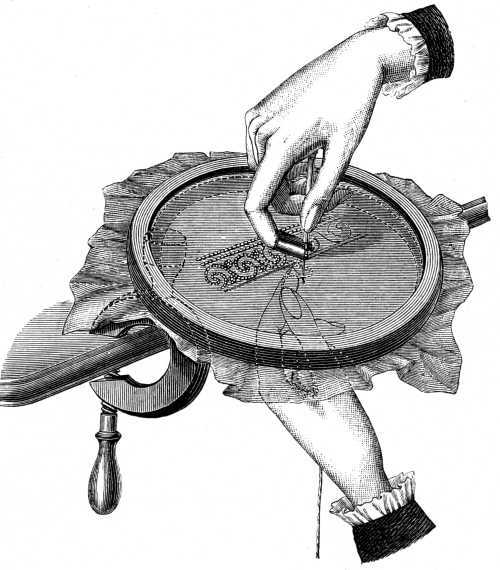
The bit I always want to see is what’s happening underneath. In Thérèse de Dillmont’s nineteenth-century illustration of tambour embroidery, one hand guides the hook above the fabric while the other feeds thread from below. It’s a useful way to picture the movement. The hook goes down through the cloth and comes up carrying a loop. Shift it a little and do it again. A line appears on the side you can see (de Dillmont, 1886).
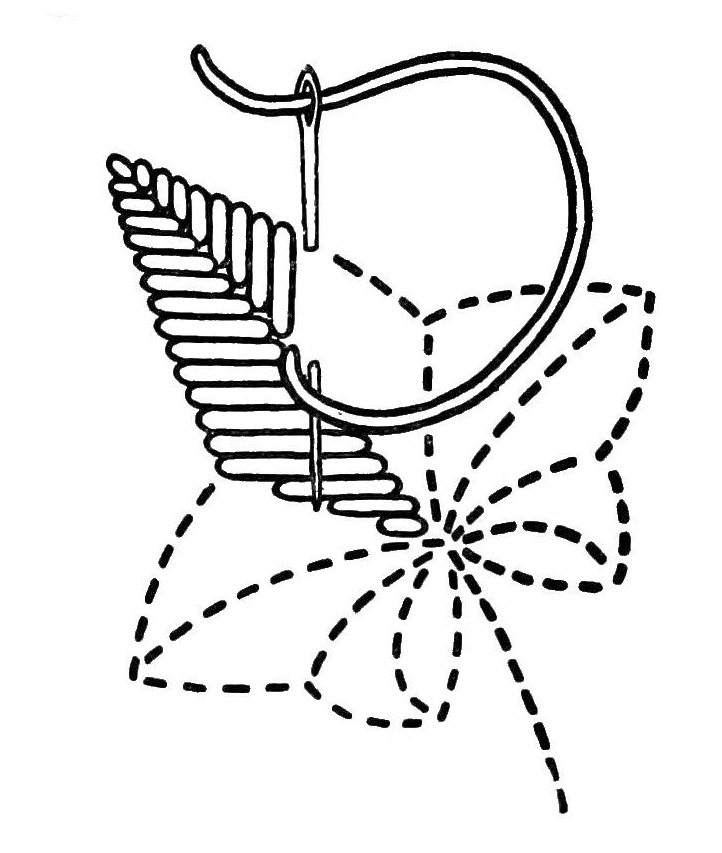
A looped line is one way to work a shape. In baspa, described as satin stitch, stitches lie close together across an area so that the thread covers the ground. If the stitches run in the same direction, the surface can catch the light as the cloth moves. Padded satin stitch, described as bedel keste, raises that surface. Think of the same small leaf drawn three ways. A chain around the edge, a smooth area of colour and a leaf that stands a little proud of the cloth (Kargabekova, n.d.; Bekova, 2018; Christie, 1921).

What survives
At Berel in the Kazakh Altai, fragments of an Early Iron Age saddle covering gave researchers enough material to reconstruct part of its decoration. They identified an animal scene and a band of plant ornament along the saddle groove. It takes a little imagination to go from fragments on a conservator’s table to the whole object, and quite a lot of patience to establish which pieces belong together. The fragments give us a view of early ornament at Berel. The later examples give us a closer look at how embroidery was placed on objects we can recognise (Altynbekov et al., 2019).
The Turkistan regional collection records an embroidered tuskiiz from the late nineteenth or early twentieth century, alongside an early twentieth-century chest cover and handkerchief. A hanging has a wall to work with. A handkerchief can be turned over in your palm. The maker has a different space to compose in each time (Turkistan regional museum, 2026).
From the yurt wall to the face
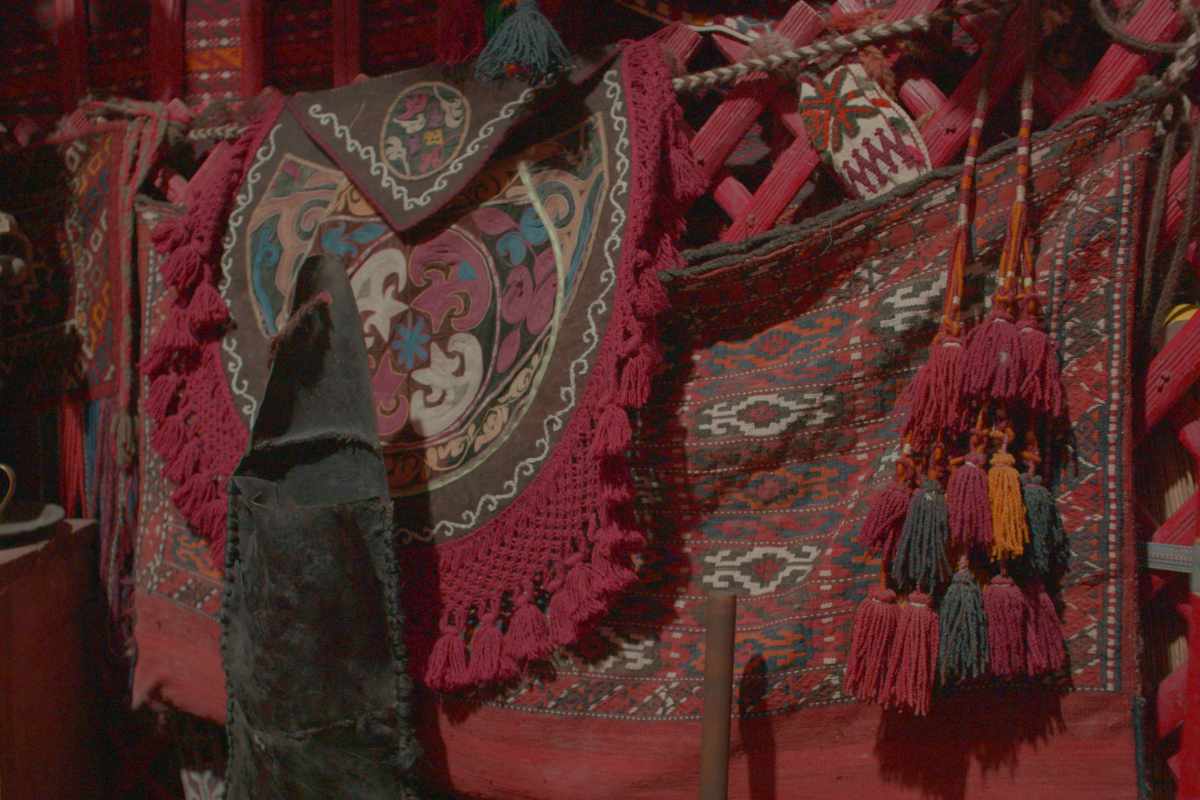
The tuskiiz, a decorated wall hanging, could be displayed against the yurt lattice and form part of a bridal dowry. Across a wall, a repeated motif can hold a broad expanse of cloth together. The photograph below gives a sense of how patterned textiles and tassels can sit together against the wooden lattice (Institute of Culture, n.d.; Turkistan regional museum, 2026).
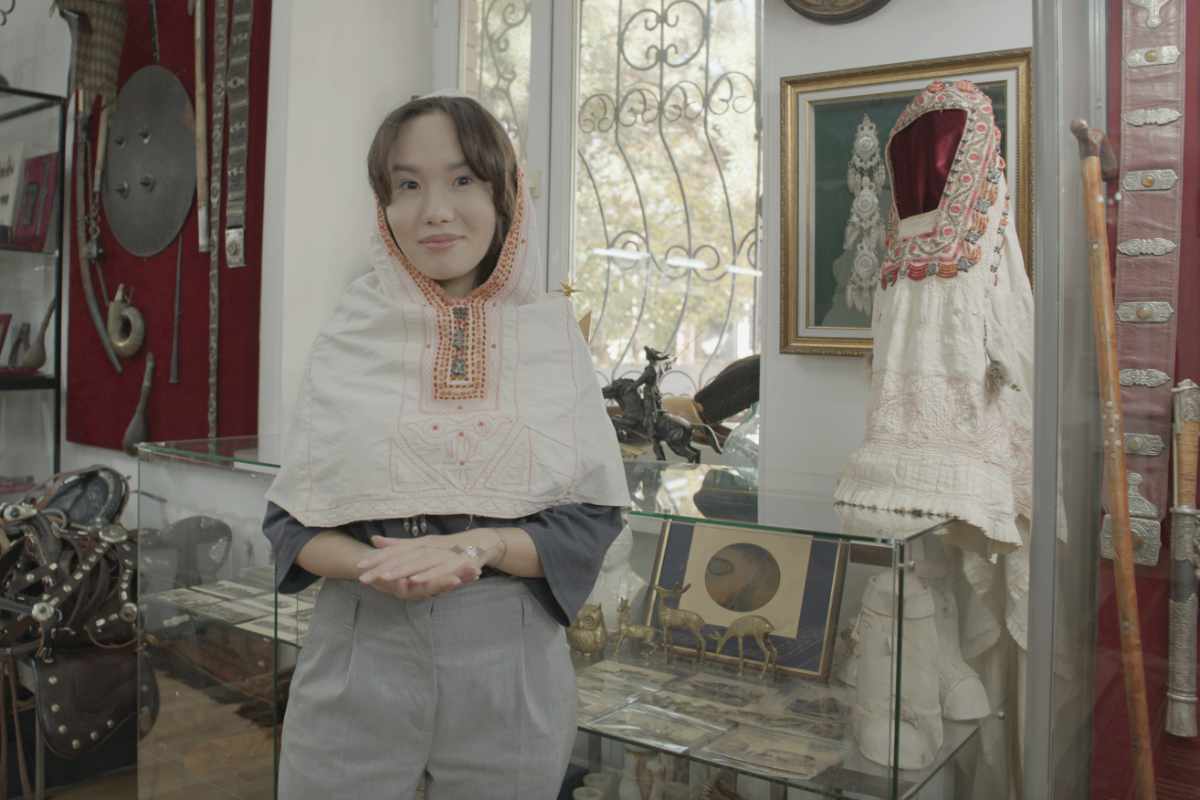
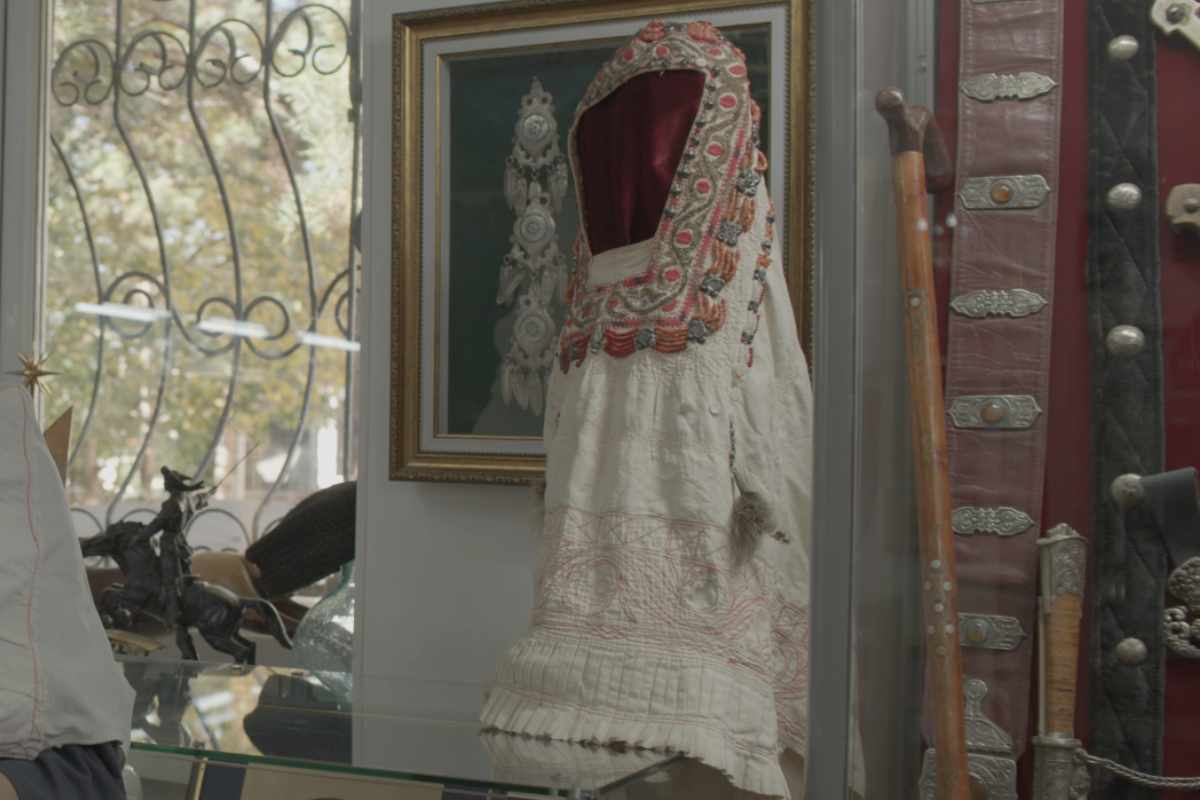
On a kimeshek, a traditional head covering worn by married Kazakh women, the opening gives the pattern a place to begin. In the one shown worn here, rows of ornament follow the edge of the face and continue down the front. In the one on display, the decoration around the opening is denser. A separate kimeshek dated to 2022 by the Zhetysu museum offers another example of how ornament can extend from the front to the sides (Institute of Culture, n.d.; Zhetysu museum catalogue, n.d.).
When the thread starts drawing
The line can also become a way to draw a figure. In Zeinelkhan Mukhamedzhan’s Korkyt (1998), embroidery is the medium for a picture. The Smithsonian’s Central Asian Lookbook also documents Botakoz Zeinelkhan making small embroidered pictures and accessories. The scale changes again. What might run the length of a hanging can now fit in a hand (Institute of Culture, n.d.; Smithsonian Center for Folklife and Cultural Heritage, 2024).
The next time you see an embroidered textile, try following one line until it turns, thickens or disappears into another colour. Then step back. Does it frame a face, hold the edge of a pattern or describe a figure? Once you start looking for those choices, the finished piece gives you glimpses of the work that went into making it.
That’s it for this week, next time, we’ll discuss alasha, the pileless wool carpet that’s woven flat.
Related stories
- Örmek weaving: How eleven strips became one Kazakh carpet
- Tekemet and syrmaq: Two ways to make a Kazakh felt carpet
Explore the Fashion, Textiles & Adornment Intensive in Almaty
References
Bekova, G. A. (2018). Kazakh National Pedagogical University bulletin, Art Education series.
Christie, Grace (1921). Satin-stitch illustration.
de Dillmont, Thérèse (1886). Encyclopedia of Needlework, “Tambour Embroidery”, fig. 844.
Institute of Culture (n.d.). Traditional Kazakh Embroidery.
Kargabekova (n.d.). Keste (Embroidery). World Crafts Council Asia Pacific.
Smithsonian Center for Folklife and Cultural Heritage (2024). Central Asian Lookbook.
Turkistan regional museum (2026). Kazakh embroidery from the collection.
Zhetysu Regional Museum (n.d.). Kimeshek collection record. Object dated 2022.