
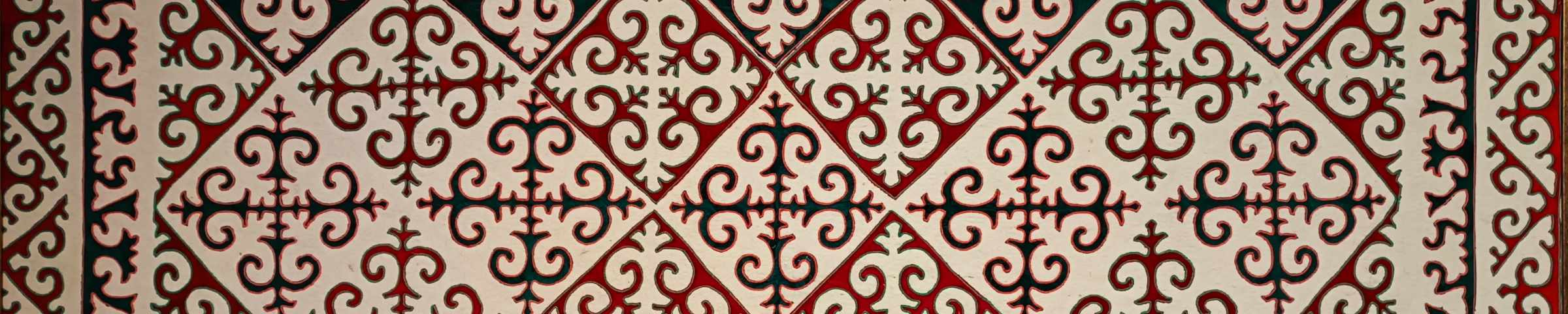
Early twentieth-century syrmaq-style carpet in the National Museum of Kazakhstan, Astana. Photo: Zenwort · CC BY-SA 4.0 · Resized for web; cropped for the banner display.

KAZAKHSTAN · TEXTILES & MAKING
Tekemet and syrmaq: Two ways to make a Kazakh felt carpet
In this story
First, a little woolTekemet: The pattern goes in earlySyrmaq: Cut the pattern, then join itTry this the next time you see oneWhen you first glance at two Kazakh felt carpets (Tekemet and Syrmaq) they can look like cousins from across the room. However, if you take a closer look, and ask one question: when did the pattern go in? you’ll find your answer and it’s kinda neat, although I always forget to look.
You see with a tekemet, the ornament commonly goes in while the wool is becoming felt. With a syrmaq (also spelled syrmak), the maker often starts with felt that’s already made, then cuts and joins it, et voilà. Think coloured wool worked into a surface on one side, a puzzle cut from sheets of felt on the other. Of course there are variations on both, which is part of what makes them interesting, there’s always an interpretation, which is the cool part (Kargabekova, n.d.; Shoibekov and Utebayeva, 2022).
First, a little wool
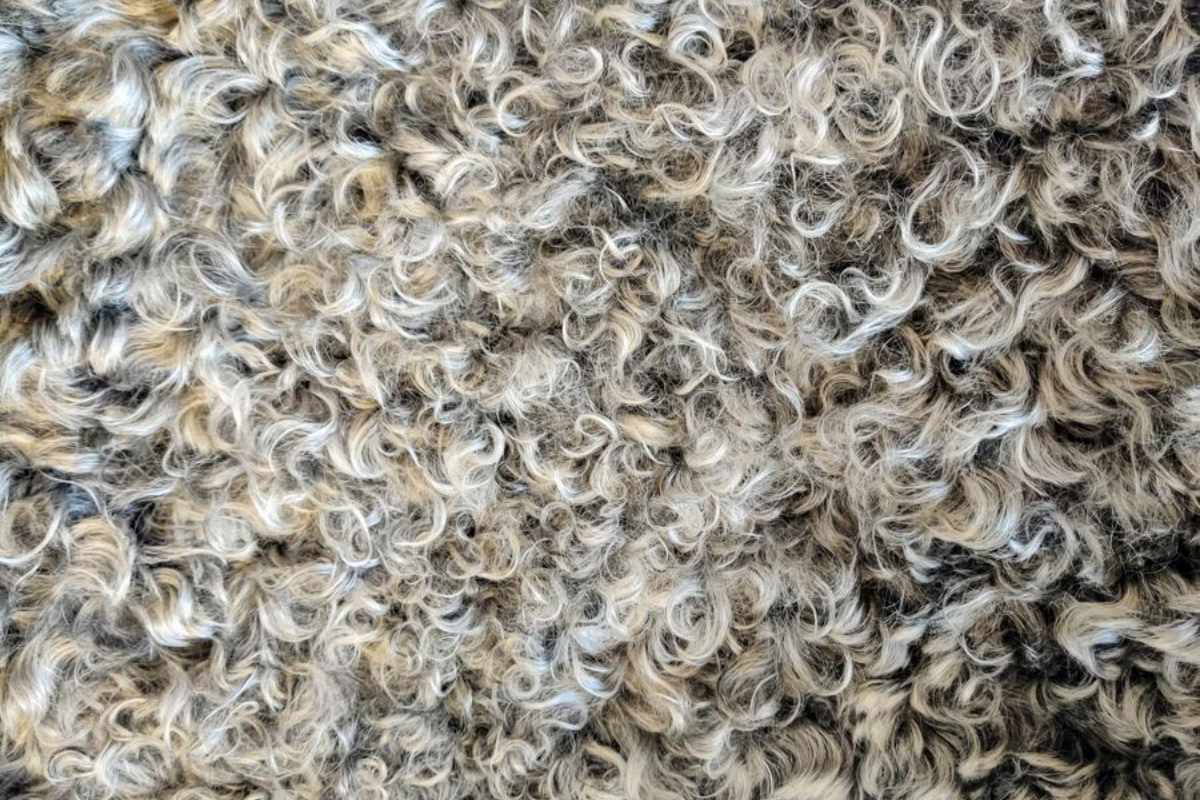
Look closely at the edge of a piece of woven cloth and you can see where the threads cross. For the felt experts out there this type of felt works differently. Gone are the rows of interlaced threads. In wet felting, water and movement help the wool fibres tangle together; pressure compacts the layers. If you’re curious to see what that involves, then the Smithsonian’s account of textile artist Mereke Aidarsha takes you from loose wool through laying, wetting and rolling, it’s fascinating, but don’t worry we’ve added links. (Ewald, 2024).
Tekemet: The pattern goes in early
Picture the design laid out in coloured wool on top of a wool base. It looks one way before you roll it. Now imagine the whole thing shrinking as you work it. A maker has to account for that movement before they start, so there is an element of pre-planning. The loose fibres can give a softly mingled edge; shapes cut from partially felted wool can stay more distinct (Kargabekova, n.d.).
The Atamura Museum records a tekemet made by Beden Zhalgasbayeva in 1938. At roughly two by three and a half metres, it was a substantial gift for her daughter, Alua Aknazarova. The family later donated it to the museum. That puts a maker and a recipient back into a story that’s easy to tell only in terms of patterns and processes, textile artists are also story tellers! (Atamura Museum, n.d.).
Syrmaq: Cut the pattern, then join it
This sounds a little complicated, but stick with me. Take two sheets of felt in contrasting colours. In one mosaic method, the maker cuts the same shape from both, then swaps the cut pieces. A dark shape fits into a light background and a light shape into a dark one. The pieces are stitched together, sometimes with an outlining cord called zhiyek. Other syrmaq makers use appliqué or combine methods, it’ss like lego, well the fitting together bit, not the plastic part, there’s no plastic involved just to be clear (Kargabekova, n.d.; Shoibekov and Utebayeva, 2022).
Look at the dark-brown and cream syrmaq attributed to Maisara Yernazarova in the A. Kasteyev Museum catalogue. The shapes interlock like a puzzle and a cord traces the joins. If you’ve ever made a quilt, the idea of planning and joining pieces may feel familiar, because it kinda is. Felt has its own thickness and edges, though, and the comparison only takes you so far (A. Kasteyev State Museum of Arts, n.d.).
Try this the next time you see one
Follow the boundary between two colours. Look for fibres crossing it, a cut edge, a stitch or a raised cord. If you can see the reverse, look for joins and repairs. Then check what the maker or museum calls the object. Crisp edges alone won’t tell you how it was made, and even a familiar horn-shaped motif doesn’t have one meaning everywhere (Ageleuova, 2023; Kargabekova, n.d.).
It takes a lot of hands and decisions to get from a pile of wool to a carpet. That knowledge has been passed on through household work and teaching, and it still gives artists something to work with today.
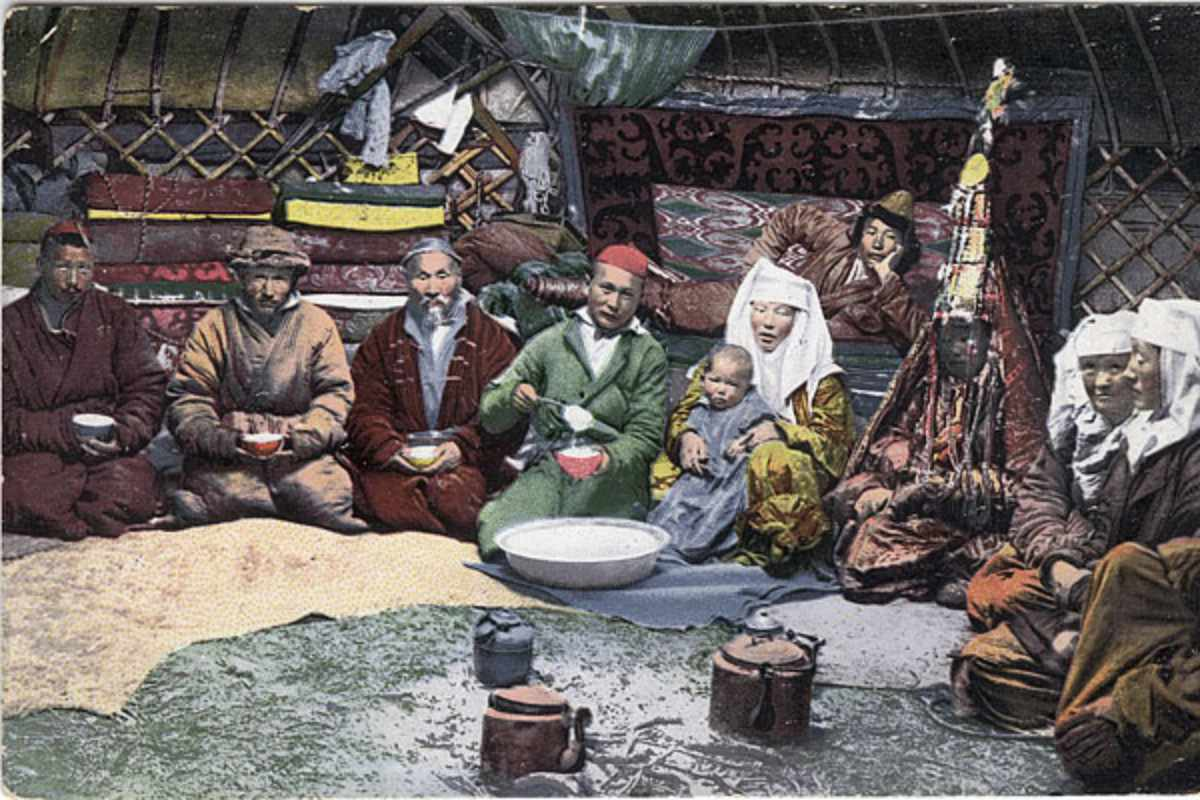

The next time a carpet catches your eye, try looking for the bit that took the maker the longest (Sarov and Issayeva, 2026; Yeskozhina and Zhukenova, 2025).
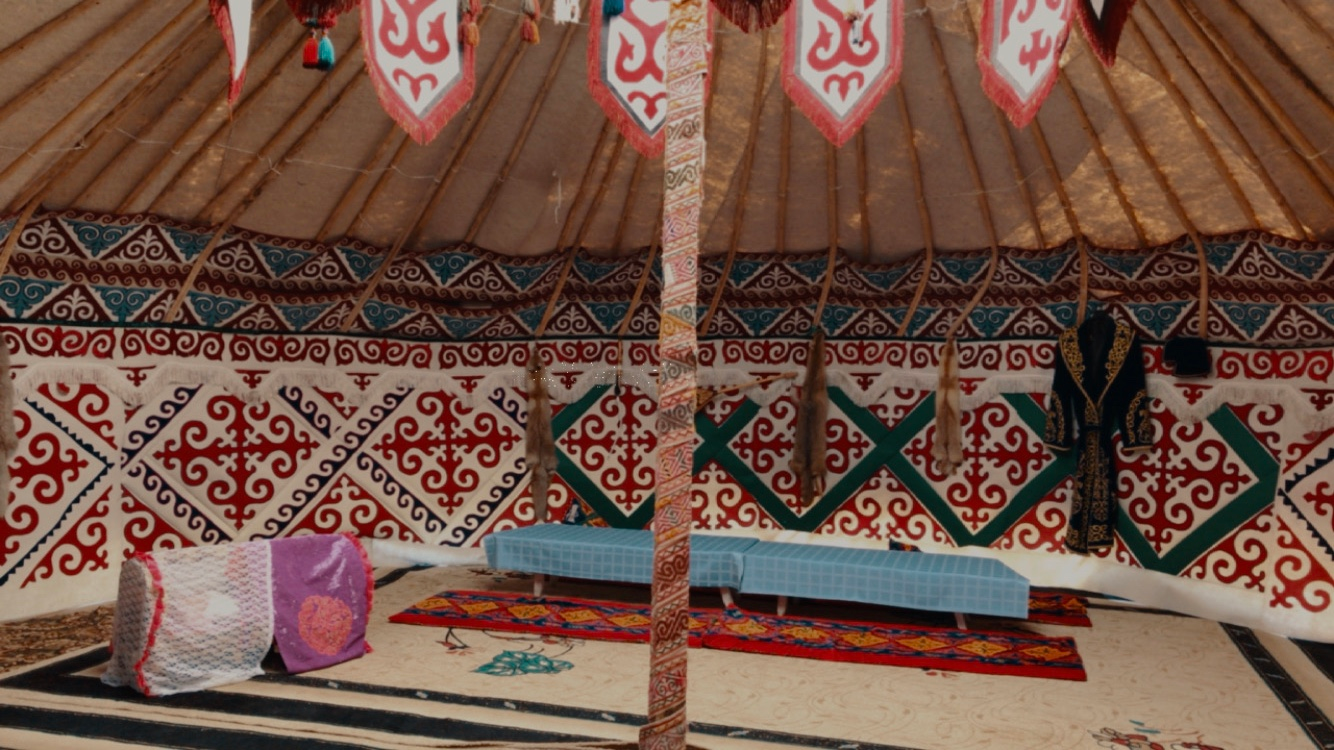

Related story: Örmek weaving: How eleven strips became one Kazakh carpet
Explore the Fashion, Textiles & Adornment Intensive in Almaty
References
A. Kasteyev State Museum of Arts (n.d.) ‘Felt Floor Carpet (Syrmak)’, E-Museum Kazakhstan, catalogue record attributed to Maisara Yernazarova, 1950s. Available at: Read the source (Accessed: 11 November 2026).
Ageleuova, A. (2023) ‘Carpet weaving on the territory of Kazakhstan as a reflection of the traditional worldview of nomads’, Acta Via Serica, 8(1), pp. 31–54. Available at: doi.org/10.22679/avs.2023.8.1.002 (Accessed: 11 November 2026).
Atamura Museum (n.d.) ‘Tekemet’, E-Museum Kazakhstan, object record of Beden Zhalgasbayeva’s carpet, 1938. Available at: Read the source (Accessed: 11 November 2026).
Ewald, K. (2024) ‘Weaving Through Kazakhstan’s Cultural Heritage’, Smithsonian Folklife Magazine, 3 June. Available at: Read the source (Accessed: 11 November 2026).
Kargabekova, R. (n.d.) ‘Tekemet and Syrmakh’, The Encyclopedia of Crafts in the WCC-Asia Pacific Region. Available at: Read the source (Accessed: 11 November 2026).
Sarov, S.B. and Issayeva, A.I. (2026) ‘The problem of traditional felt and carpet weaving among Kazakh women (19th–early 20th centuries)’, Journal of History, 121(2). Available at: doi.org/10.26577/JH2121202613 (Accessed: 11 November 2026).
Shoibekov, P. and Utebayeva, E. (2022) ‘Kazakh traditional art of felt carpet’, Journal of History, 106(3), pp. 208–217. Available at: doi.org/10.26577/JH.2022.v106.i3.021 (Accessed: 11 November 2026).
Yeskozhina, L. and Zhukenova, Z. (2025) ‘The path of felt: tradition and transformation in Kazakh contemporary art’, Textile: Cloth and Culture, 23(3–4), pp. 675–688. Available at: doi.org/10.1080/14759756.2025.2524884 (Accessed: 11 November 2026).