
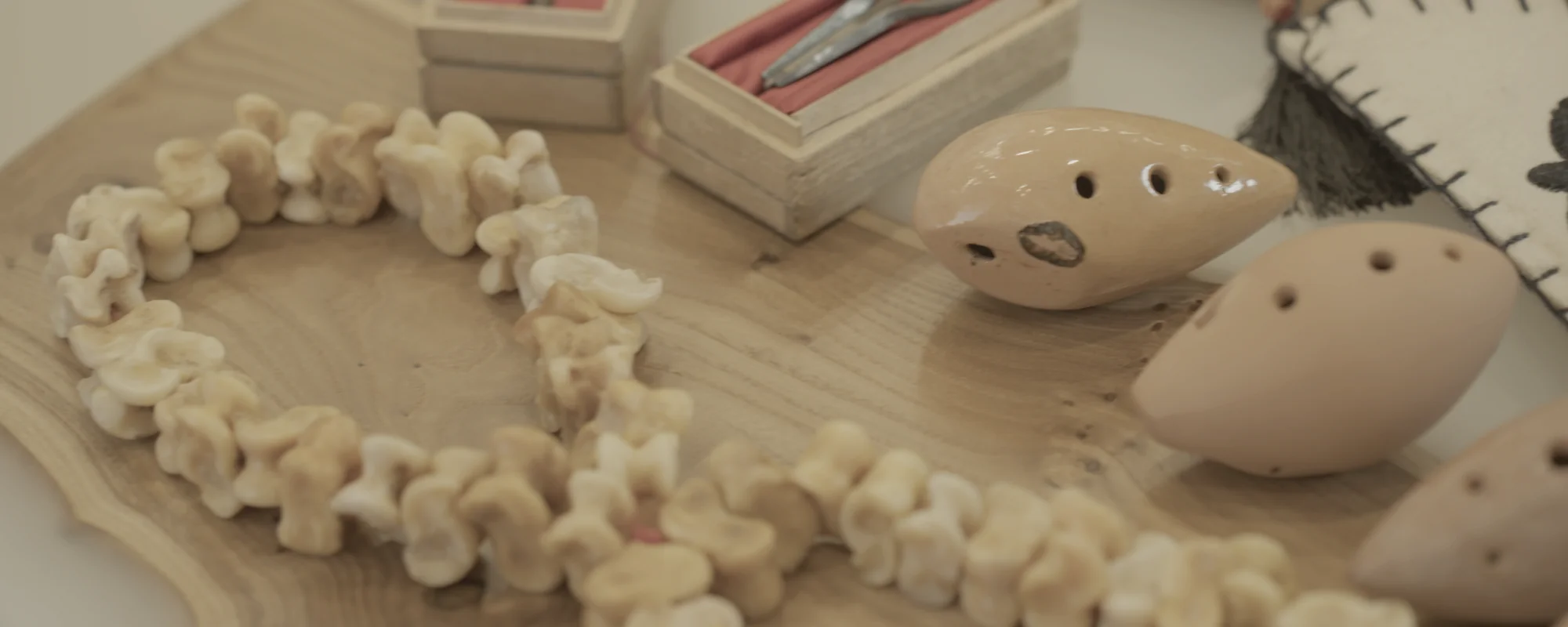
Caption: Yedil Khussainov’s ethno-instruments
Photo: Kristoffer Bübeck, Astana, Kazakhstan, 2025
ATLAS & NATION STORIES
The Sound of the Steppe: Exploring Kazakhstan’s Traditional Instruments
In this story
Some instruments sound like strings.
Some sound like breath.
Others seem to bring with them the sound of movement: a horse at a distance, the wind across open land, the trace of a human voice.
Kazakhstan’s traditional instruments are more than a collection of curious objects. They belong to intertwined histories of storytelling, ceremony, everyday life and performance. Wood, horsehair, animal skin, clay, reeds, metal and breath all shape their sound.
The dombra is widely recognised as a symbol of Kazakh musical culture. But beyond it lies an extraordinary family of instruments: the bowed qyl-qobyz, the plucked zhetigen and sherter, the wind-blown sybyzgy, the mouth-resonated shankobyz, and clay instruments such as the saz syrnai.
Some have continued through established performance traditions. Others have been researched, reconstructed or adapted for contemporary ensembles. Understanding these differences makes the story richer.
They are not simply exhibits from the past.
They are part of a living musical culture.
Music as a way of remembering
For generations, Kazakh songs, instrumental pieces and epic narratives were shared through performance and listening. Oral transmission shaped the relationship between music and memory: a piece could be associated with a performer, place, story or event.
An important form is the küi (also written kui or kyui), an instrumental composition closely associated with instruments such as the dombra and qobyz. A küi can communicate a narrative, a mood or an experience without words.
Music was therefore not only entertainment. In particular contexts, it was a way of telling stories, remembering people, marking social occasions and communicating with a community. The meanings and functions varied across traditions and periods.
To understand the instruments, it helps to listen for the world of stories around them.
A living encounter with Yedil Khussainov
During our filming in Kazakhstan, musician and multi-instrumentalist Yedil Khussainov demonstrated the zhetigen for Atlas & Nation.
Watching a musician play brings an instrument into focus. The position of the hands, the touch of the fingers and the response of the strings reveal something a museum label cannot. An unfamiliar shape becomes a working instrument, understood through the skill of the person playing it.
The zhetigen: seven strings, seven laments
The zhetigen is a plucked string instrument traditionally associated with a celebrated story about seven sons. In the account presented by Aisha Dossumova, a father loses each of his seven sons during a famine. He adds a string after each death and plays a lament, until the instrument holds seven strings and the memory of seven losses (Dossumova, 2016).
It is an origin legend, not a documented record of a single historical invention. That distinction does not make the story less meaningful. It tells us what generations of listeners and musicians have associated with the instrument: grief, remembrance and the expressive power of strings.
Older forms and modern reconstructions may differ in their number of strings and mechanical details. This is not unusual when instruments enter new educational and concert settings.
The legend asks us to hear the zhetigen not merely as a plucked instrument, but as an invitation to listen for memory.
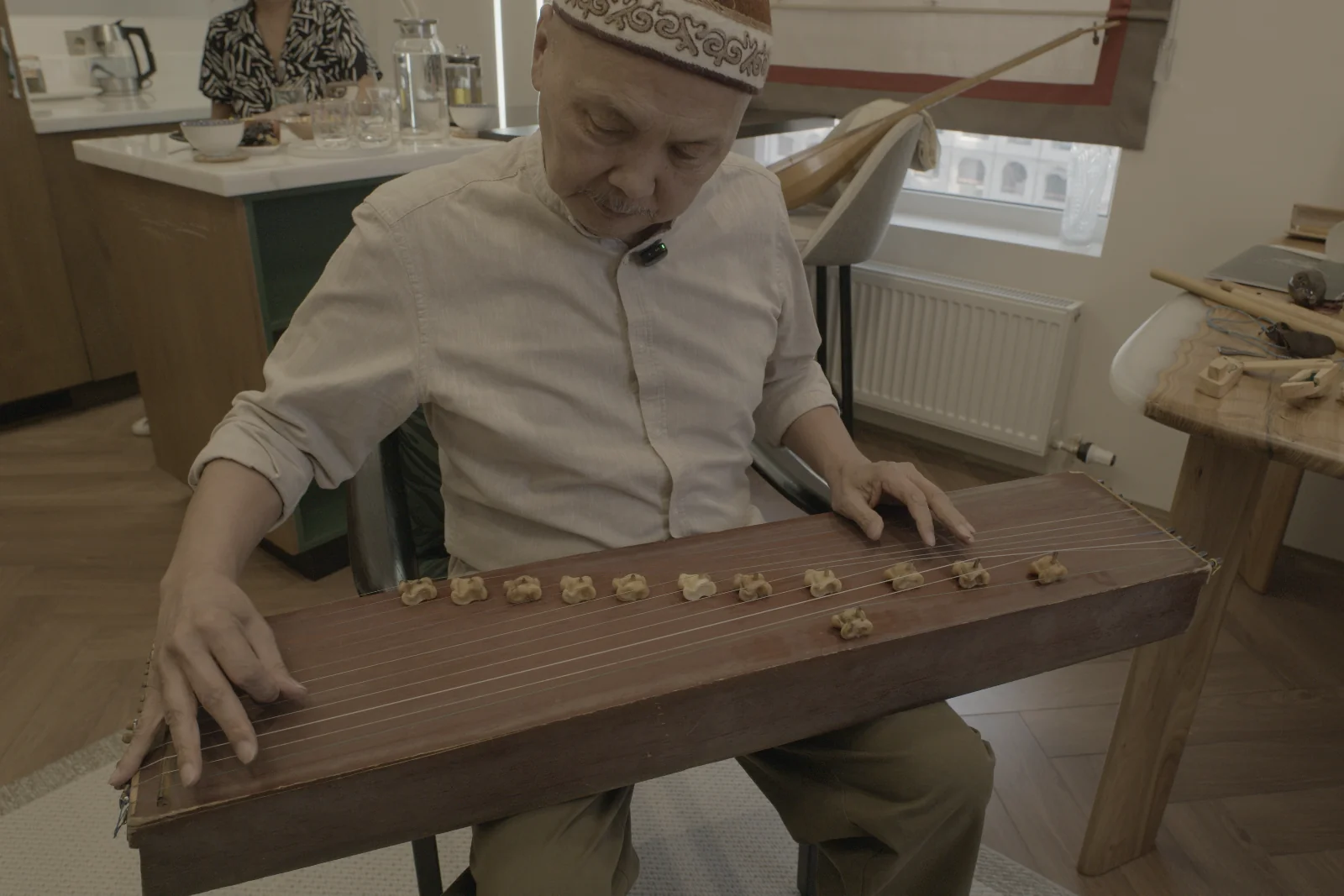
Caption: Yedil Khussainov playing the zhetigen
Photo: Kristoffer Bübeck, Astana, Kazakhstan, 2025
Dombra: rhythm, storytelling and the küi
Long-necked and generally two-stringed, the dombra is one of the most recognisable instruments of Kazakhstan. It accompanies songs and stands at the centre of a rich instrumental küi tradition.
Two broad performance approaches are frequently distinguished. Tökpe is often associated with vigorous, flowing strumming, while shertpe is commonly associated with a more delicately articulated plucked manner. Dossumova describes their contrasting techniques and expressive qualities (Dossumova, 2016).
These are useful introductions, rather than exhaustive definitions of all regional practice. A dombra performance may be forceful, intimate, playful, reflective or intensely dramatic.
For a first-time listener, watch the right hand and listen to how rhythm creates character. The instrument’s expressive range is greater than its spare silhouette might suggest.
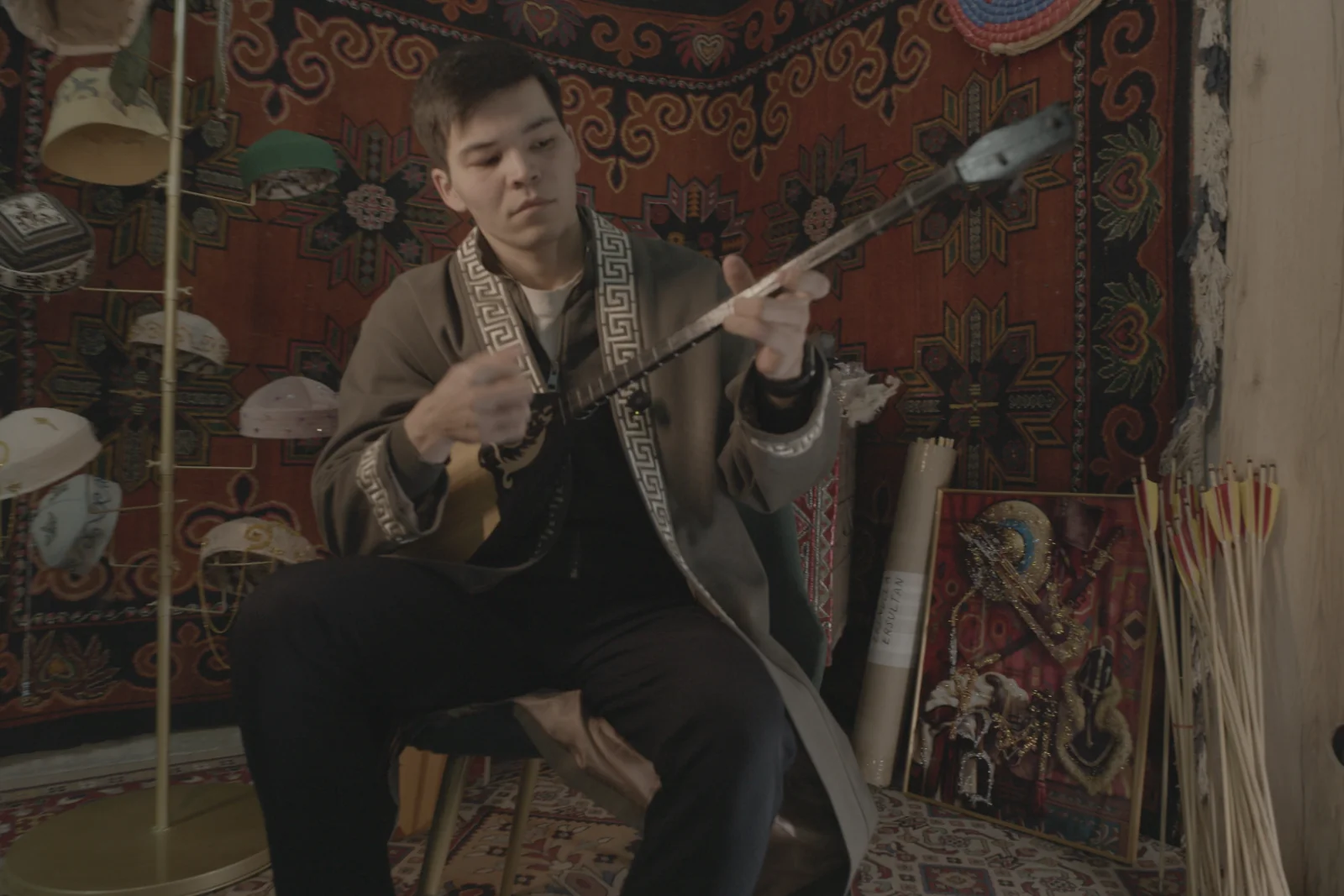
Caption: Nuralla Orynbassarov playing dombra
Photo: Kristoffer Bübeck, Astana, Kazakhstan, 2025
Qyl-qobyz: horsehair and a voice-like sound
The qyl-qobyz, a traditional form of the qobyz (also written kobyz), has horsehair strings and a striking, textured timbre. The player typically holds it upright, using a bow to draw sound from the strings.
It has associations with ritual practice, epic performance and stories surrounding the legendary musician Korkut. In one well-known account, Korkut plays music in an attempt to resist death. This is a legend illustrating the instrument’s place in cultural imagination, not a verifiable biography.
Dossumova discusses both traditional qobyz technique and its associations with natural sounds: performers may evoke animals, wind or vocal expression through sliding pitches, harmonics and changes of bowing (Dossumova, 2016).
The qyl-qobyz can sound raw, resonant and uncannily close to the human voice. Its material construction is part of that experience.
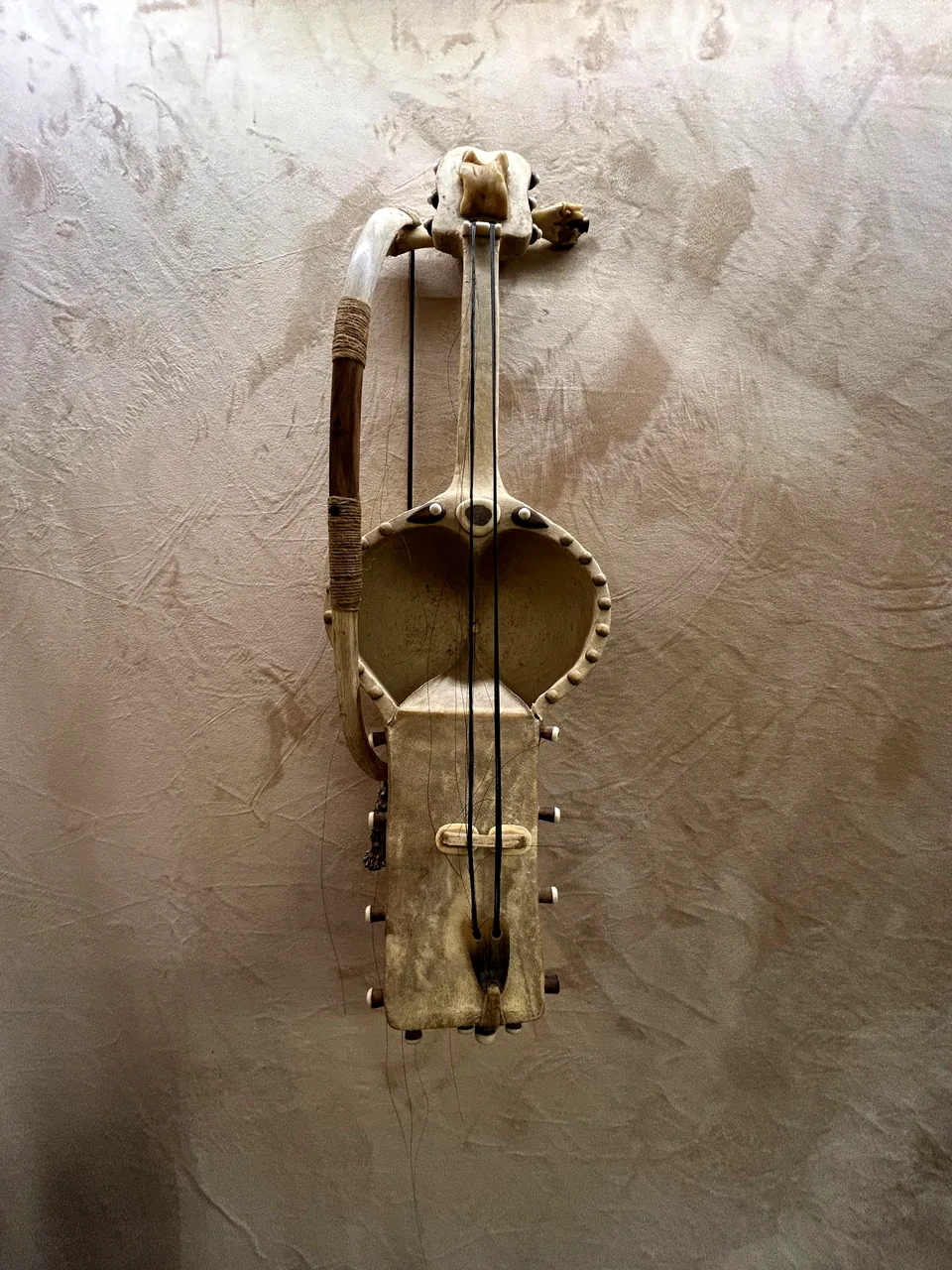
Caption: Gaukharbek Kunkhozhayev, kobyz instrument
Photo: Kristoffer Bübeck, Turkistan, Kazakhstan, 2025
Prima-kobyz: an instrument adapted for the concert stage
The prima-kobyz is not simply another name for the qyl-qobyz. It is a modernised bowed instrument developed within the history of Kazakh folk orchestras and concert performance.
Junussova, Utegalieva and Bulatova describe the prima-kobyz as a modernised bowed-string instrument developed for twentieth-century orchestral and concert performance, associated with ensemble and solo music-making (Junussova, Utegalieva and Bulatova, 2024).
Its history demonstrates that tradition involves adaptation as well as preservation. When musicians perform in new spaces, the instrument itself may change.
This is not necessarily a loss of authenticity; it is part of the story of musical practice across generations.
Sherter: a different voice among the strings
The sherter is a short-necked plucked instrument associated with Kazakh musical heritage. Dossumova describes older forms with few strings and associations with pastoral life (Dossumova, 2016).
Its inclusion broadens the picture beyond the familiar dombra. Kazakh string instruments have varied in materials, dimensions, playing techniques and circumstances of performance.
Where an identified sherter is available, compare it directly with a dombra: their resemblance becomes a way of noticing their differences.
Sybyzgy: music shaped by breath
The sybyzgy is a flute-like wind instrument connected in traditional accounts to pastoral life. Smakova and colleagues describe instruments made from materials such as reed or cane, wood and metal, with a soft, breath-led tone (Smakova et al., 2016).
A sybyzgy performance encourages close attention to the musician’s control of air and phrasing. Its seemingly simple form can carry complex melodic expression.
Shankobyz: the player’s mouth becomes the resonator
The shankobyz is a small metal reed instrument, comparable in broad construction to a jaw harp. It produces its characteristic changing sound through the interaction of a vibrating element and the player’s mouth.
Shifts in tongue position, lips and oral cavity help shape the audible tones. It can look modest in the hand, then produce a sound far larger and more complex than expected.
Watch how changes in the player’s mouth reshape the sound.
Saz syrnai and uskirik: sound from clay
Not every Kazakh instrument is made from strings or reeds. Some traditional and reconstructed wind instruments are shaped from clay.
Smakova and colleagues describe the saz syrnai as a clay wind instrument, and the uskirik as a small vessel-like instrument sometimes associated in description with the form of a bird (Smakova et al., 2016).
These objects unite the interests of a musician and a maker. Their appearance, material and construction are inseparable from the notes they produce.
An instrument can be a piece of sculpture and still belong fully to the world of music.
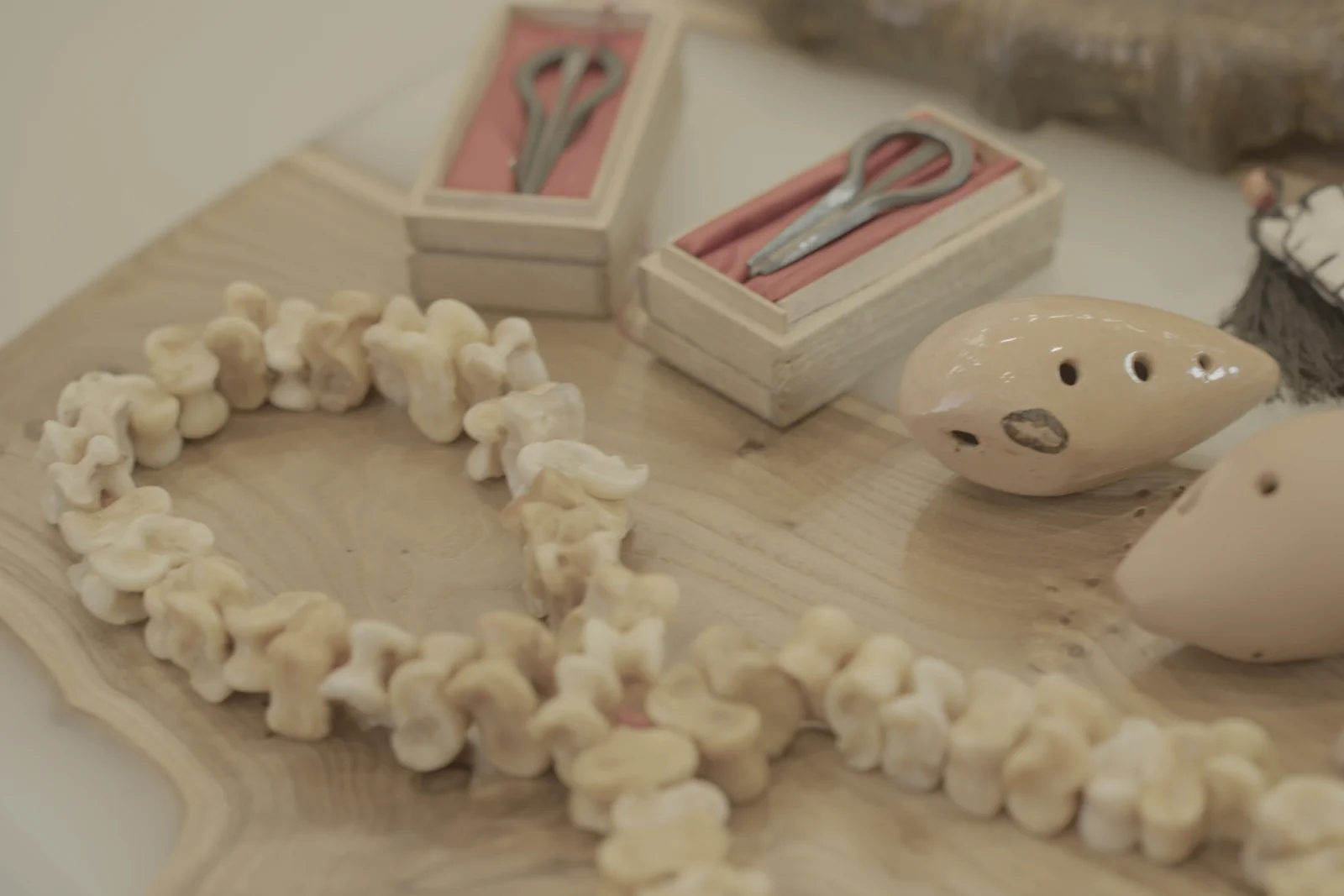
Caption: Yedil Khussainov’s ethno-instruments
Photo: Kristoffer Bübeck, Astana, Kazakhstan, 2025
Percussion: calling, signalling and gathering
Drums and percussion instruments have appeared in accounts of hunting, ceremony, travel and communal occasions, as well as musical performance.
Smakova and colleagues discuss instruments including dangyra, dabyl and dauylpaz (Smakova et al., 2016). Their particular forms and uses should not be collapsed into one universal purpose.
What these examples suggest is that sound could help organise social life, marking a moment that mattered beyond the performance itself.
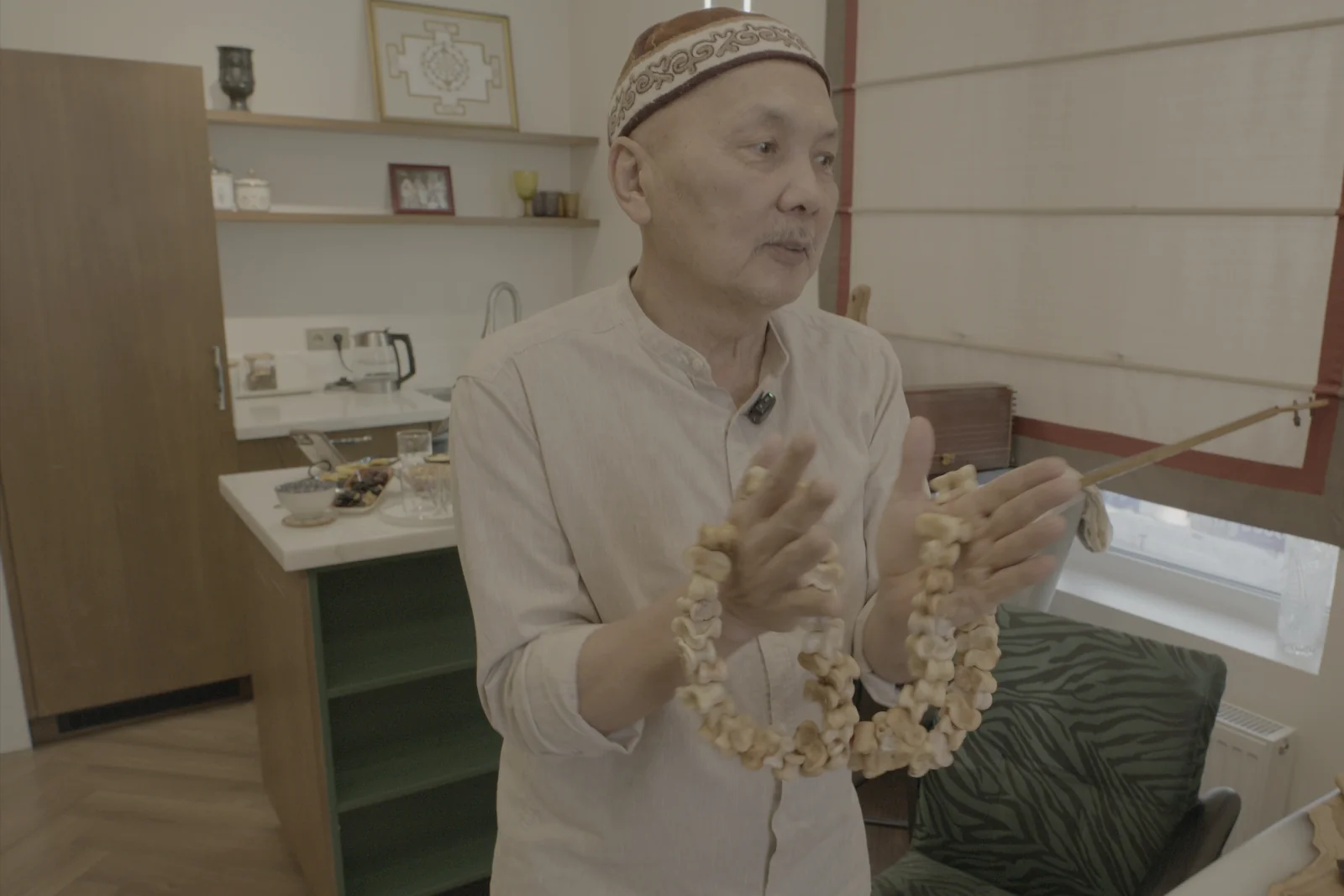
Caption: Yedil Khussainov, ethno-musician & composer
Photo: Kristoffer Bübeck, Astana, Kazakhstan, 2025
Bolat Sarybayev and the work of revival
Some instruments encountered on contemporary stages owe their continued visibility not simply to uninterrupted use, but to scholars, collectors, makers and musicians who investigated older forms.
Dossumova describes Bolat Sarybayev’s important contribution to researching and reviving Kazakh folk instruments (Dossumova, 2016).
Reconstruction asks difficult questions. Which surviving object or written description can be trusted? How might its materials have shaped the sound? How should a modern performer learn to play an instrument that fell out of regular use?
The work combines historical inquiry with practical experimentation. A recreated instrument is both a bridge to inherited knowledge and a new object made in the present.
From solo performance to the ensemble
Kazakh musical traditions have a strong history of solo performers: singers, narrators and instrumentalists whose individual voices could carry an entire piece.
The twentieth century brought new ensemble and orchestral approaches. Ayaulym Zhumkenova describes the development of collective instrumental performance, including changing repertoires and the place of older instruments in contemporary ensembles (Zhumkenova, 2025).
Today’s performances may bring the dombra, qobyz, zhetigen, sherter and other instruments together in combinations that would not have been typical in earlier settings.
That change is worth hearing in its own right: a sound once associated with a single player can become one voice in a larger musical texture.
How to listen as a traveller
Recordings can introduce the sounds. Museums can show construction and history. Concerts bring a living repertoire into the room.
But a close encounter with a musician offers another perspective. Watch how an instrument is held. Notice where hands move and how the body contributes to sound. Ask about the materials, the repertoire and the stories musicians choose to tell.
Listen to the dombra’s rhythmic attack, the qyl-qobyz’s bowed texture, the zhetigen’s plucked resonance, or the shankobyz’s intimate relationship with the human mouth.
Rather than collecting names, try to follow one instrument from object to sound, from technique to story.
That is where the music becomes more than a cultural introduction.
It becomes a conversation.
Travel deeper with Atlas & Nation
Atlas & Nation is developing creative experiences in Almaty centred on encounters with Kazakhstan’s living cultural traditions, including music and the people who perform, build and reinterpret it.
For musicians, composers, sound artists and curious travellers, traditional instruments offer a remarkable entry point into the country’s creative life.
A photograph can introduce an instrument. A recording can let you hear it.
But meeting the people behind the sound adds a different kind of understanding.
Explore more Atlas & Nation stories →
Resources and recommended reading
This list brings together the sources cited in the article and additional background reading consulted during its development.
Dossumova, A. (2016) The Influence of Kazakh Folklore on the Development of Violin Performance in Kazakhstan. Doctor of Musical Arts monograph. Temple University. Available at: https://scholarshare.temple.edu/bitstreams/57f42d50-20d1-48da-907f-2d1520993f41/download (Accessed: 21 October 2026).
Junussova, B., Utegalieva, S. and Bulatova, D. (2024) ‘Kazakh prima-kobyz and Kyrgyz prima-kyyak: the experience of the comparative study’, Musicologist, 8(2), pp. 210–232. doi: 10.33906/musicologist.1312914. Available at: https://doi.org/10.33906/musicologist.1312914 (Accessed: 21 October 2026).
Smakova, Z., Karsakbayeva, A., Rakymzhan, A., Kalymova, G., Kudaibergenova, S., Gaissin, A. and Takisheva, A. (2016) ‘Ethnomusical traditions of the Kazakh people: past and present’, Man in India, 96(11), pp. 4651–4664. Available at: https://serialsjournals.com/abstract/29027_ch_38_-_smakova_et_al_article_man_in_india.pdf (Accessed: 22 October 2026).
Utegalieva, S., Alsaitova, R., Mykyshev, T., Medeybek, M. and Ongarbayeva, S. (2019) ‘About Two Types of Universalism in the Musical Instruments of the Kazakhs’, Opción, 35(88), pp. 567–583. Available at: Publisher’s article page (Accessed: 22 October 2026).
Zhumkenova, A. (2025) ‘Reviewing ensemble forms in Kazakh music-making’, AEMR, 15, pp. 110–115. doi: 10.30819/aemr.15-11. Available at: https://www.logos-verlag.eu/PDFS/aemr.15-11.pdf (Accessed: 21 October 2026).
Leave a Reply