
Creative Practice / Position
How to Find Your Creative Direction Without Forcing a Style
A practical guide to understanding your work and using Position — Volume 2.
By Kristoffer Bübeck
Have you ever placed several pieces of your creative work side by side and wondered whether they belong together? One might be colourful and expressive. Another is restrained and minimal. A third looks as though it was made by someone else entirely. Perhaps you’re drawn to several artistic styles, or you enjoy working with different materials and techniques. It’s easy to interpret this variety as a problem.
Maybe you haven’t found your style. Perhaps your work lacks identity. Perhaps you should settle on one recognisable visual approach. But what if that isn’t the answer? Creative direction isn’t necessarily about making everything look alike. It’s about recognising the choices, questions and interests that connect your work. Comparing the work may help you recognise connections that are difficult to notice piece by piece.
That’s the starting point for Position — Creative Identity & Direction, the second workbook in the Atlas & Nation collection.
Why finding your style can be frustrating
Advice about developing an artistic identity is often surprisingly vague. Keep practising. Be yourself. Your style will emerge. Those suggestions aren’t necessarily wrong, but they provide little practical help when you’re trying to understand a collection of apparently unrelated work. You might be attracted to several styles, struggle to recognise a personal visual language or want greater coherence across your projects. Start by looking at the choices in the work itself.
These concerns don’t necessarily mean the work lacks identity. A photographer might approach different subjects using contrasting visual techniques. A textile designer may explore both restrained geometric structures and expressive organic surfaces. An illustrator could use different materials depending on the project. Variation isn’t automatically inconsistency. The more useful question may be: What do I continue to care about, even when the appearance of my work changes?
To investigate that question, begin with the creative evidence you already have.
Seven steps to recognise a direction in your work
Position contains seven stages: Notice → Trace → Distil → Define → Position → Direct → Commit The workbook begins with your existing work and gradually moves towards a clearer creative direction. You don’t need to have completed Explore first. Gather three to five examples of your own practice. They could be drawings, photographs, material samples, class projects or unfinished experiments. Let’s follow a hypothetical textile designer who has made several different pieces but struggles to understand what connects them.
1. Notice — Recognise what keeps appearing
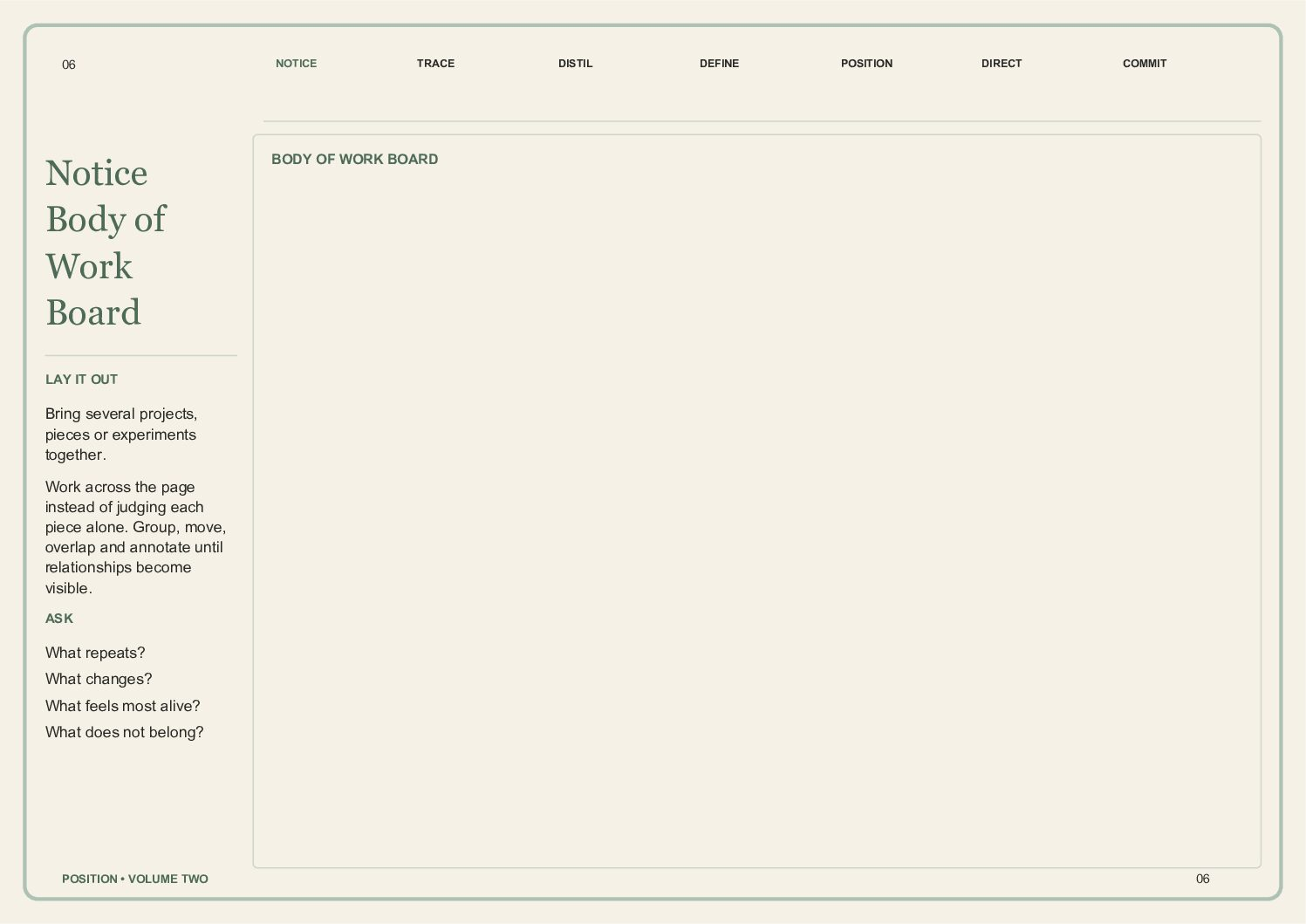
Workbook page 4: Notice / What Repeats
Begin by looking across several pieces rather than judging each one individually. Our textile designer gathers a woven sample, a printed fabric study, a collection of sketches and a mixed-media experiment. The pieces look very different. But when they’re arranged together, certain qualities begin to emerge. Several use muted colours. Others contain repeated geometric forms. Many combine highly structured arrangements with irregular surfaces. These observations may suggest a relationship worth investigating.
On the Notice page, record recurring subjects, visual qualities, materials and working methods. Also consider which choices seem intentional and which may simply be habitual. You can use the Body of Work Board on page 6 to arrange images and samples visually. Don’t rush to name a style.
What to record: A small collection of recurring qualities that you can actually see across your work.
2. Trace — Understand your influences
Workbook page 10: Trace / Where It Comes From
Now consider where those qualities might come from. What artists, designers, places, materials or experiences have influenced your decisions? Our textile designer might recognise an interest in architectural geometry, traditional weaving structures and the irregular surfaces of handmade objects. But identifying an influence isn’t enough. Ask what you admire about it. Is it a particular technique? A way of arranging forms? A relationship between material and meaning? And what have you done differently?
Perhaps the designer admires the precision of geometric architecture but deliberately introduces irregularity through hand stitching. That contrast may be important. Trace helps you investigate the relationship between your references and the choices you’ve developed yourself. Record sources and makers where relevant, particularly when working with traditions or cultural material. If a reference comes from a specific weaving practice, identify the maker, place and context rather than treating it as an anonymous visual resource.
What to record: A clearer understanding of your influences and where your own decisions begin to diverge from them.
3. Distil — Identify what matters
Workbook page 16: Distil / What Matters Most
By now, you’ve probably identified several recurring qualities and influences. But not everything needs to become part of your next project. The Distil page asks you to identify what is worth keeping, questioning or leaving behind. For our textile designer, the strongest qualities might be:
- Repeated geometric structures.
- Irregular handmade surfaces.
- Restrained colour relationships.
- A recurring interest in the contrast between precision and imperfection.
Other elements might be less important. Perhaps bright colours appeared in one project because they were required by a brief. Perhaps a particular technique was used simply because the equipment was available. Distil helps separate meaningful creative preferences from temporary or habitual decisions. Try reducing what matters to three or four qualities.
What to record: A small group of creative characteristics that feel important enough to investigate further.
4. Define — Clarify your point of view
Workbook page 20: Define / What I’m Really Exploring
Visual qualities tell us something about how work looks. But creative direction can also involve the questions, values and ideas beneath those choices. Ask what you’re interested in exploring through your practice. Our textile designer might recognise a recurring interest in the relationship between order and imperfection. That idea could become a working statement: I’m interested in how structured patterns change when they’re shaped by hand, material and chance. It doesn’t need to sound like a finished artist statement.
It simply gives the work a clearer focus. The Define pages encourage you to investigate the questions you repeatedly return to, what matters to you and what you want people to notice or experience. Don’t feel obliged to describe your entire creative identity in one sentence. You’re identifying a direction for the work you’re making now.
What to record: A provisional statement describing an interest or question that connects several pieces of your work.
5. Position — Make your creative language visible
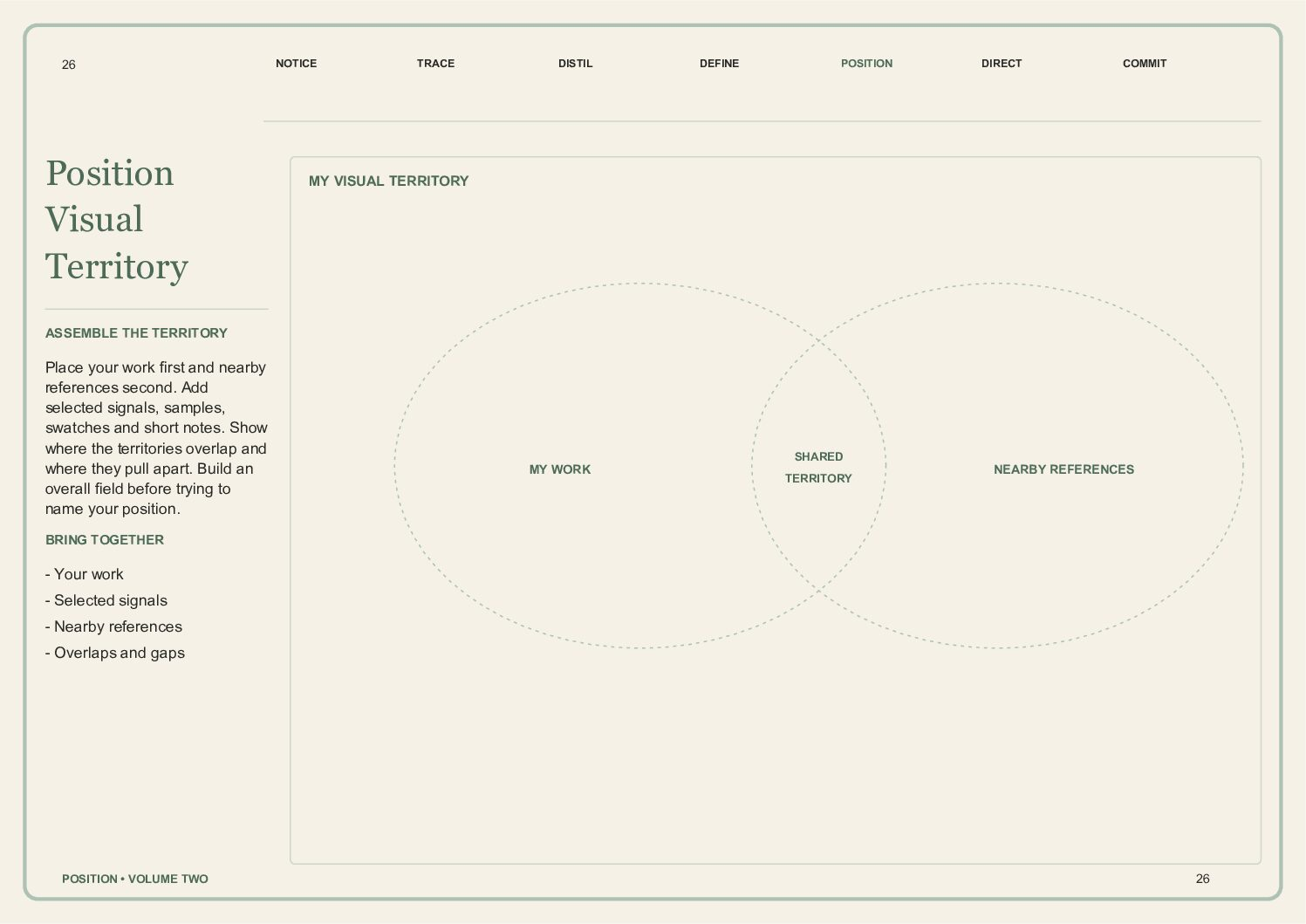
Workbook pages 24–26: Visual Language Lab and Visual Territory
This stage asks you to explore how your interests become visible through creative choices. On the Visual Language Lab, you can translate a theme or question into marks, motifs, colours, forms, materials and rhythms. Our textile designer might explore the contrast between order and imperfection through a regular woven grid interrupted by loose, uneven threads. Another experiment might combine precise shapes with irregular colour boundaries. The point isn’t to create one permanent visual identity.
It’s to test how an idea can be communicated through different forms. On the Visual Territory page, you can arrange your work alongside related references and consider where they overlap and differ. What qualities feel shared? What combinations feel particular to your own approach? Where are you beginning to develop a distinct direction?
What to record: A visual arrangement showing how your interests, materials and creative choices relate to one another.
6. Direct — Choose what to develop
Workbook page 30: Direct / Choose What to Push
Once you’ve recognised the strongest qualities and interests in your work, it’s time to choose a direction to investigate. Position encourages you to compare three possible routes. For our textile designer, these might be: Direction A: Explore interrupted geometric patterns through weaving. Direction B: Investigate irregular surfaces through hand stitching and layered materials. Direction C: Combine architectural structures with fragile, translucent textiles.
All three emerge from the earlier research, but each has a different emphasis. Print or duplicate page 30 for each of your three routes, then compare the pages side by side. Consider their relevance, energy and room for development. Which gives you something useful to learn, and which would you like to investigate? Choose one route and use the following pages to develop variations. Keep the other routes as possibilities you can revisit.
What to record: One creative direction worth developing, supported by your observations and experiments.
7. Commit — Create a visual direction
Workbook pages 34–37: Commit and Creative Direction Board
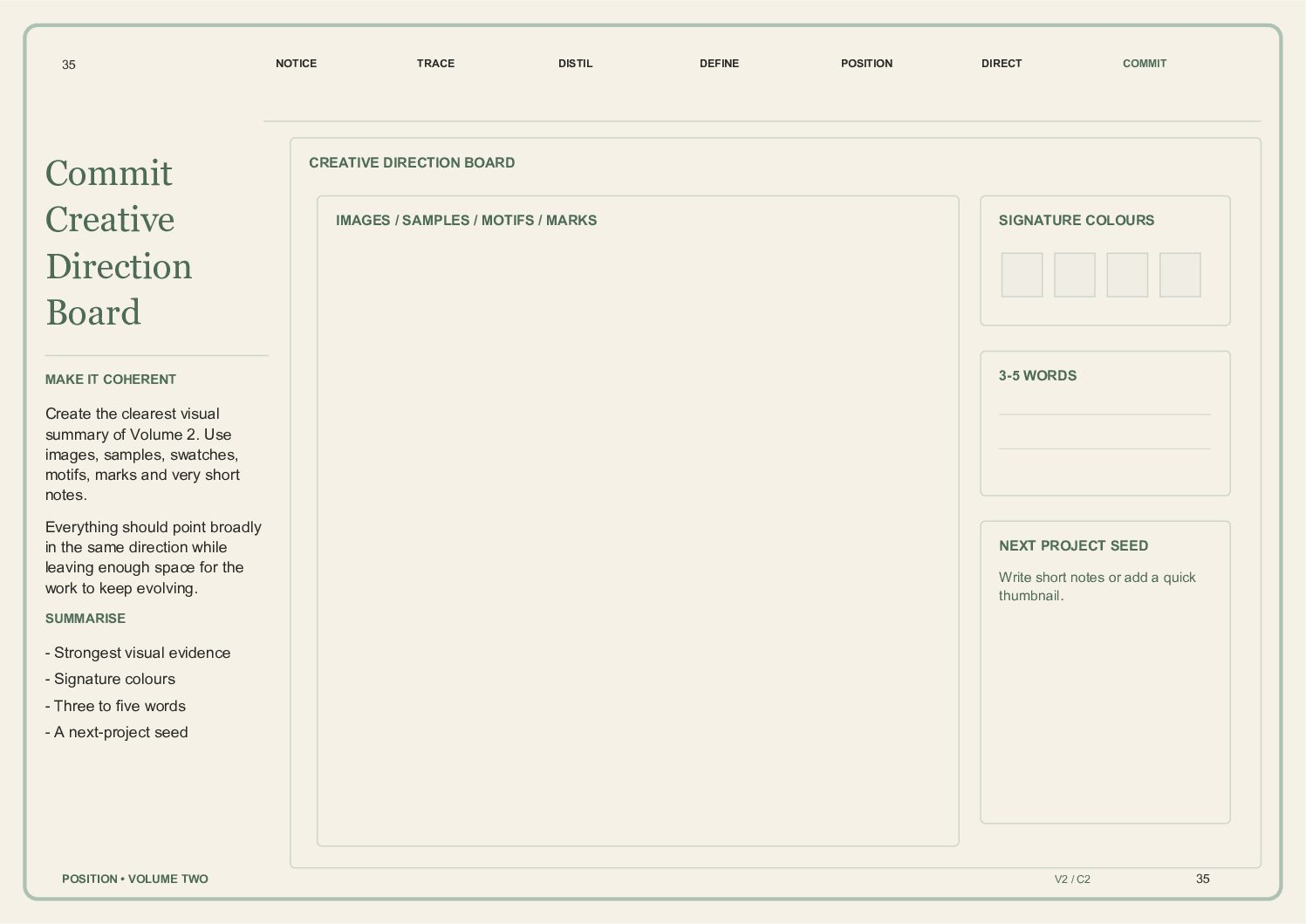
The final stage brings the strongest elements together. Use your selected images, sketches, materials, colour relationships and visual experiments to communicate the direction you’ve chosen. The Creative Direction Board on page 35 provides a place to arrange your strongest signals. Include relevant images, material samples, colours and a few words describing the qualities you want to develop. Our textile designer might finish with a board combining irregular woven structures, restrained colours and architectural references.
A working statement could be: Exploring the tension between geometric order and handmade irregularity through woven and stitched textiles. Page 37 then provides a visual handover for the next project. You can record the important materials, methods, boundaries and a possible starting idea. This is a direction you can act on—not a permanent definition of who you are as a designer.
What to record: A visual direction board and a clear starting point for further creative development.
A practical exercise: find the thread in your work
You can try a simplified version of Position using a few pieces of work you already have. Arrange three to five drawings, photographs, samples or creative projects where you can see them together. Look for three qualities that appear more than once. Now ask which qualities represent a deliberate creative choice and which might simply be habits. Choose one important influence and identify how your own work differs from it. Then write a short sentence beginning: I keep returning to…
Finally, sketch one new experiment that combines two of the recurring qualities you’ve identified. Place it beside your earlier work. Does it reveal a relationship you hadn’t noticed? Does it suggest a direction you’d like to investigate? You don’t need to find a permanent artistic style. The exercise is designed to help you understand your work more clearly and make a purposeful next decision.
Position is not about becoming predictable
A working direction can guide your next project while leaving room to change. You might explore the same concerns through different materials, develop several visual approaches or challenge a recurring habit. Return to the evidence in your work when deciding what to keep and what to try differently.
From scattered work to a clearer direction
Position — Volume 2: Creative Identity & Direction is a 40-page workbook containing guided exercises, visual comparison boards, influence mapping, material and visual-language studies, and space to develop a creative direction. It is designed for artists, designers, students and independent makers who want to understand the relationships across their existing work.
You can begin with Position directly. If you need experiments to compare, Explore helps you develop initial possibilities. When you have a chosen direction and work ready for further development, Resolve supports refinement, making and presentation. The workbook doesn’t promise to reveal a unique, permanent style. Instead, it provides a practical way to examine your creative decisions and identify a direction worth developing.
Explore the workbook
Preview the opening 10 pages of Position, including Notice and the start of Trace. See the complete 40-page digital workbook for the full process through to a creative direction board and next-project handover.