
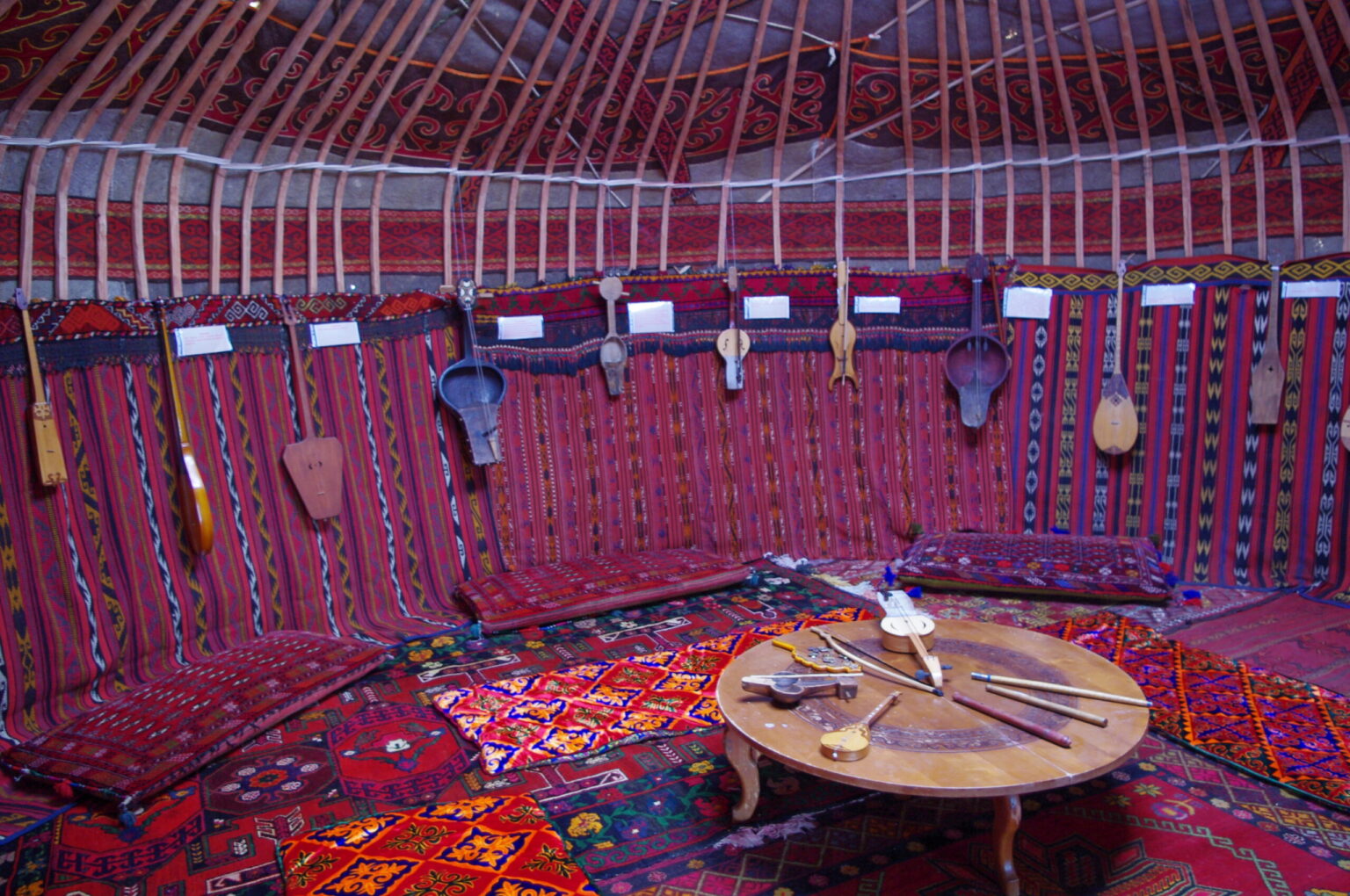
Traditional Kazakh musical instruments displayed inside a yurt. Photograph: Ken and Nyetta (2012), Wikimedia Commons, CC BY 2.0. Resized for web; cropped for the banner display.

ATLAS & NATION STORIES
Rare Kazakh Ethno-Instruments: The Search for Lost Instruments
In this story
How do you bring back the sound of an instrument when nobody can tell you exactly how it was played?
Imagine discovering an illustration of an unfamiliar stringed instrument in an old book.
You can see its body, neck and strings. You might be able to estimate its proportions. But the drawing cannot tell you how the instrument sounded, how a musician held it, or which melodies belonged to it.
What happens when someone decides to build it anyway?
This is one of the questions at the heart of Kazakhstan’s remarkable history of musical reconstruction.
Some traditional instruments survived through generations of performance, passed from musician to musician. Others became increasingly difficult to find. Their forms survived in photographs, illustrations, written descriptions, archaeological objects and personal recollections.
And then, during the twentieth century, researchers and musicians began trying to bring some of these instruments back into public life.
Their work raises a fascinating question: when we reconstruct something from the past, are we preserving history or creating something new?
The musician who went looking for forgotten sounds
Bolat Sarybayev (1927–1984) was a Kazakh musicologist, collector and researcher whose work transformed the study and performance of traditional musical instruments.
Beginning in the mid-twentieth century, Sarybayev investigated instruments that had become rare or fallen out of widespread use.
His research took him beyond concert halls and conservatoires. He drew on historical descriptions, musical knowledge, surviving instruments and other evidence to understand how these objects had been constructed and used.
Among the instruments associated with his research were the sherter, saz syrnai, uskirik, shankobyz, asatayak and several forms of traditional percussion.
What made Sarybayev’s work particularly significant was that he was interested not only in documenting these instruments but also in restoring them to musical practice.
An instrument could be collected and exhibited. It could be measured, described and photographed.
But could it be played?
Could a musician learn its techniques? Could it join other instruments in an ensemble? Could new audiences recognise it as part of Kazakhstan’s musical heritage?
These were practical questions as well as historical ones.
In 1968, Sarybayev organised an ensemble featuring traditional instruments, helping establish a performance context for sounds that many audiences rarely encountered (Isakhan and Isakhanova, 2017).
His work contributed to a wider movement in which research, instrument-making and musical performance became closely connected.
To understand why that mattered, we need to examine an instrument whose modern existence tells a particularly unusual story.
The sherter: rebuilding an instrument from an image
The sherter is a traditional plucked-string instrument, usually described as smaller than the dombra, with a short neck and a distinctive body.
Yet its modern revival was not simply a matter of finding an old instrument and making an exact copy.
Musicologist Valeriya Nedlina describes how Sarybayev’s reconstruction drew on an image recorded by the nineteenth-century Polish exile and observer Bronisław Zaleski.
The illustration provided a visual reference, but a picture is not a complete set of construction instructions.
According to Nedlina, an early reconstruction based on this visual evidence was not playable. Further work drew on field research and creative interpretation to produce a functional instrument (Nedlina, 2023, pp. 41–42).
That is an extraordinary detail.
The attempt to recover a historical object had produced something that looked towards the past but still required decisions in the present.
The proportions, construction, strings and playing possibilities all had to work together. Where historical evidence was incomplete, interpretation became unavoidable.
Nedlina consequently raises questions about how directly the reconstructed sherter can be connected to its historical predecessor.
The modern instrument is not merely an archaeological curiosity. It has developed a place in ensemble performance and musical education.
Yet that success does not necessarily mean every aspect of the older instrument has been recovered.
Perhaps this is what makes the sherter so interesting.
Its revival reveals the delicate boundary between historical preservation and creative reconstruction.
A drawing helped recover a form. Research helped guide its development. Musicians gave it a new performing life.
But reconstruction could not eliminate every uncertainty about the original sound.
When clay becomes music

The sherter is only one example of Kazakhstan’s broader musical heritage.
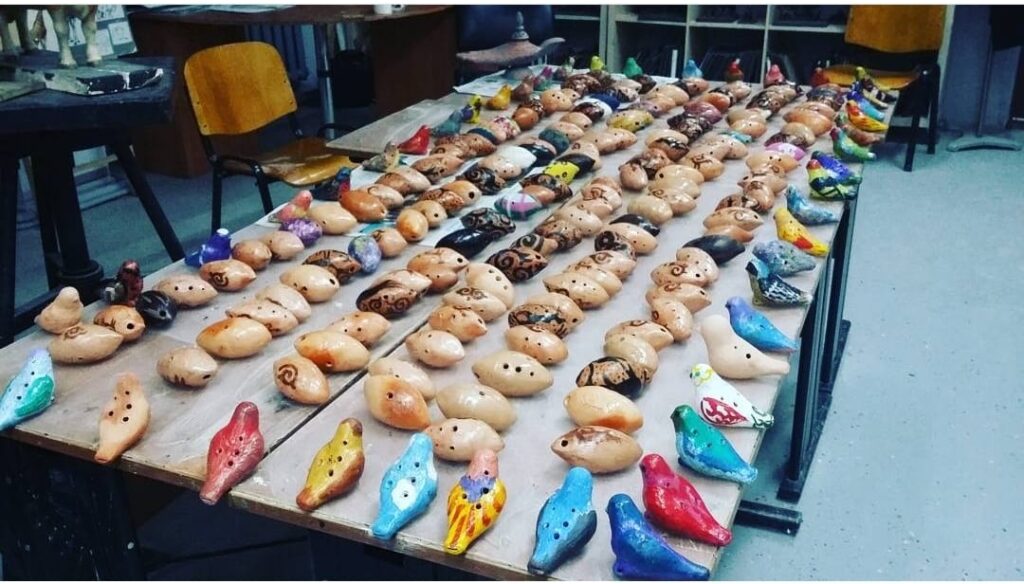
Consider the saz syrnai, a small clay wind instrument often compared with an ocarina.
Unlike stringed instruments, whose sound comes from vibrating strings, the saz syrnai produces sound through breath moving through a hollow ceramic body.
Its material is significant.
Clay can be shaped by hand, hollowed, pierced and fired. The physical form of the object determines its musical possibilities.
For a ceramic artist, this creates a fascinating relationship between sculpture and sound.
The object must be made carefully enough to function as an instrument, yet its shape can also have a distinctive visual character.
Another clay instrument, the uskirik, is commonly described as a small whistle, sometimes made in the form of a bird.
These instruments remind us that musical heritage cannot be understood through sound alone.
There is also the process of making.
The selection of material. The shaping of the object. The position of an opening. The knowledge required to produce a particular tone.
When an instrument becomes rare, knowledge of its construction may become fragile too.
Recovering its sound may therefore involve reconstructing a craft.
The instruments that depend on the body
Other traditional instruments challenge our ideas about where an instrument ends and the musician begins.
The shankobyz, a form of mouth harp, is one example.
Its vibrating tongue produces a sound that the musician shapes through movements of the mouth, tongue and throat.
The instrument is small, but the human body becomes an essential part of its acoustic system.
Without the performer, it is an incomplete musical experience.
The sybyzgy, a traditional flute associated with pastoral life, offers another relationship between material and body.
Historically made in forms using cane or other suitable materials, it relies on breath and control to create its characteristic sound.
These instruments belong to a world in which music could be portable, personal and closely connected to daily life.
But we should be cautious about assuming their histories were identical.
Some traditions continued among particular musicians and communities. Others experienced periods of decline, adaptation or revival.
An instrument may be rare in one city yet remain familiar elsewhere.
And the absence of an instrument from an orchestra does not necessarily mean it has disappeared from cultural life.
Sound beyond entertainment

Not every traditional sound-making object was intended primarily for melody or concert performance.
In Kazakh musical history, percussion instruments and sounding ritual objects had roles connected with ceremony, communication and communal activity.
The asatayak, a staff-like instrument fitted in some forms with metal rings or pendants, produces sound through movement.
Its rattling and ringing qualities have historical associations with ritual practice.
The dangyra, a percussion instrument, is likewise connected in the literature with ceremonial traditions.
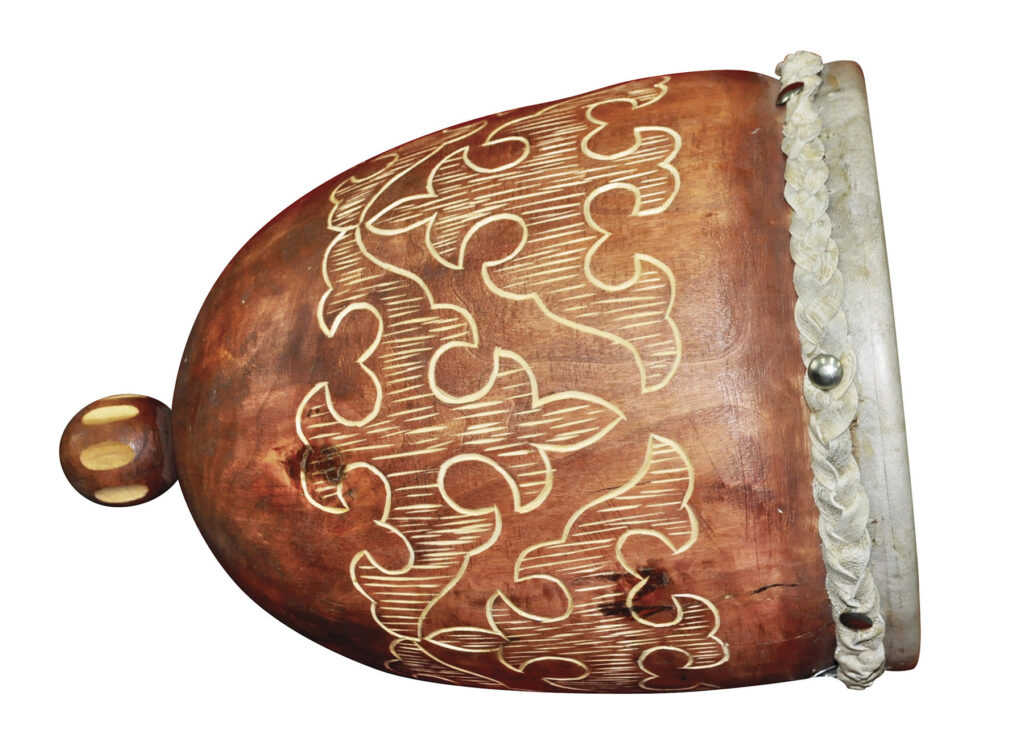
Other drums and percussion instruments, including dabyl and dauylpaz, have been associated with signalling and collective activity.

These different functions are important.
Today, we commonly encounter traditional instruments on stages, in museums or through recordings. Those settings encourage us to think of them as objects made for musical presentation.
Historically, however, sound could have practical, ceremonial and social functions that do not fit neatly into the modern concert experience.
When such objects enter an orchestra or public performance, their context changes.
Their physical forms may be preserved or adapted, but their meanings and uses can change alongside them.
That is another aspect of revival worth examining.
From research collection to concert stage
Sarybayev’s work unfolded during a much broader transformation of Kazakh musical practice.
In the early Soviet period, the development of organised folk-instrument orchestras had already introduced new arrangements, instruments and approaches to collective performance.
Later, ethnographic research helped bring additional instruments into ensembles.
Nedlina identifies several major waves of innovation: the development of orchestral performance, the reconstruction of rare instruments during the 1970s and 1980s, and more recent experimentation with new ensembles and neo-folk approaches (Nedlina, 2023).
This history complicates the idea that traditional music exists outside change.
The modern Kazakh instrumental ensemble is itself the result of artistic decisions, institutional developments and adaptation.
An instrument historically associated with an individual performer might acquire a new repertoire through ensemble playing.
A reconstructed instrument might need new teaching methods.
A sound once heard in a particular setting might become familiar to audiences through a concert stage.
None of this automatically makes the music less meaningful.
But it does mean that the traditions we encounter today often contain more than one historical layer.
There is the older instrument.
There is the surviving evidence.
There is the reconstruction.
And there is the music that performers continue to create with it.
What does it mean to preserve a sound?
Museums are essential to the preservation of musical heritage. They protect objects, document their histories and give visitors opportunities to encounter instruments they might otherwise never see.
But sound presents a particular challenge.
An instrument in a display case can reveal its shape, decoration and material. It cannot, by itself, demonstrate the relationship between instrument and musician.
Its sound requires movement.
A string needs to vibrate. Air needs to move through a hollow body. A mouth harp requires the resonating spaces of the player’s body. A percussion instrument needs to be struck or shaken.
And performance requires knowledge that an object alone cannot preserve.
That knowledge may be held in recordings, notation, teaching traditions, remembered techniques or the experience of individual musicians.
It may also be incomplete.
This is why the revival of rare Kazakh instruments is so much more interesting than a story about rediscovered artefacts.
It is a story about people interpreting evidence and deciding how to carry cultural knowledge forward.
Sometimes preservation means maintaining an uninterrupted practice.
Sometimes it means carefully documenting something that is disappearing.
And sometimes it means acknowledging gaps in the historical record while attempting to create a new performing life for an old form.
A tradition that is still being made
Today, traditional Kazakh instruments appear in orchestras, specialist ensembles, conservatoires and contemporary musical projects.
Some of these sounds have long performance histories.
Others owe part of their modern presence to researchers and musicians who reconstructed instruments from incomplete evidence.
The distinction matters, but neither history should be dismissed.
An instrument’s cultural significance does not depend entirely on whether its modern form is identical to one played centuries ago.
Its significance may also lie in the decisions made to recover it, the knowledge gathered during that process, and the music subsequently created.
That is the lasting importance of Bolat Sarybayev’s work.
He helped make it possible for people to encounter instruments that might otherwise have remained largely confined to historical descriptions and collections.
His legacy is not simply a catalogue of objects.
It is a continuing conversation between musicians, researchers, makers and the past.
And perhaps the sherter offers the clearest expression of that conversation.
An illustration survived.
Someone studied it.
Someone tried to rebuild what it showed.
The first attempt did not provide a playable instrument.
Further research and experimentation followed.
Today, musicians can perform with the modern sherter.
We cannot assume that every note reproduces an earlier sound exactly.
But we can hear what happened when people decided that a nearly forgotten instrument deserved another life.
Sometimes preserving a tradition means recognising that its future will require creativity as well as memory.
Discover Kazakhstan’s living musical traditions
At Atlas & Nation, our interest extends beyond the instruments themselves to the musicians, makers and researchers who sustain their traditions.
Our developing Almaty Creative Intensive: Music & Ethno Instruments explores opportunities for creative encounters, demonstrations and learning alongside Kazakhstan’s musical community.
For musicians, artists and curious travellers, it offers a way to approach musical heritage as something living, changing and continually interpreted.
Explore our Creative Intensives and register your interest.
Enquire about Music & Ethno Instruments →
Sources and recommended reading
Dossumova, A. (2016) The Influence of Kazakh Folklore on the Development of Violin Performance in Kazakhstan. Doctor of Musical Arts monograph, Temple University. Read the monograph.
Isakhan, G.T. (ed.) and Isakhanova, G.B. (comp.) (2017) Bolat Sarybayev — Outstanding Scientist-Ethnorganologist. Recommended bibliographical guide. Astana: Kazakh National University of Arts. Read the guide.
Nedlina, V.E. (2023) ‘Neotraditionalism and Innovations in Kazakh Instruments and Music-Making’, Saryn, 11(4), pp. 34–53. doi:10.59850/SARYN.4.11.2023.33.
Sarybayev, B. (1981) Kazakh Musical Instruments [Kazakh-language edition: Қазақтың музыкалық аспаптары]. Almaty: Öner.
Smakova, Z., Karsakbayeva, A., Rakymzhan, A., Kalymova, G., Kudaibergenova, S., Gaissin, A. and Takisheva, A. (2016) ‘Ethnomusical Traditions of the Kazakh People: Past and Present’, Man in India, 96(11), pp. 4651–4664. Read the article.
Zhumkenova, A. (2025) ‘Reviewing Ensemble Forms in Kazakh Music-Making’, Asian-European Music Research Journal, 15, pp. 110–115. doi:10.30819/aemr.15-11.
Online sources checked 29 October 2026.
Image credits
Traditional Kazakh musical instruments displayed inside a yurt. Photograph: Ken and Nyetta (2012), Wikimedia Commons, CC BY 2.0. Resized for web; cropped for the banner display.
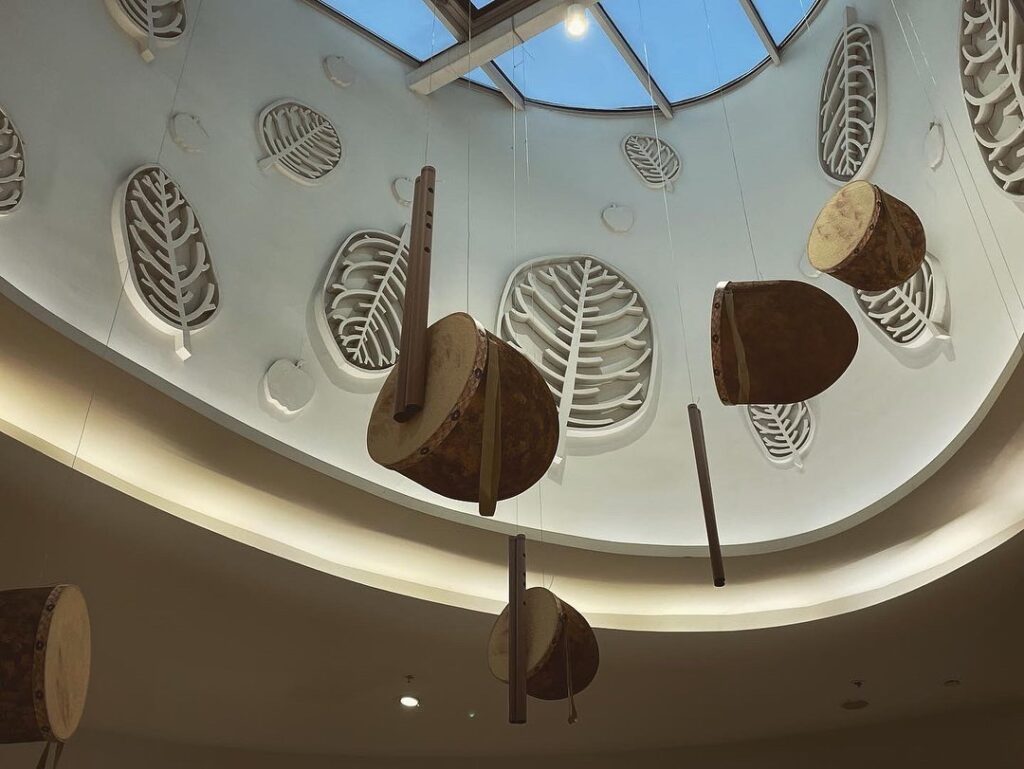
Sybyzgy woodwind instruments and dabyl percussion instruments on display in Kazakhstan. Photograph: Akbota Bakyt (2023), Wikimedia Commons, CC BY-SA 4.0. Resized for web; no crop.
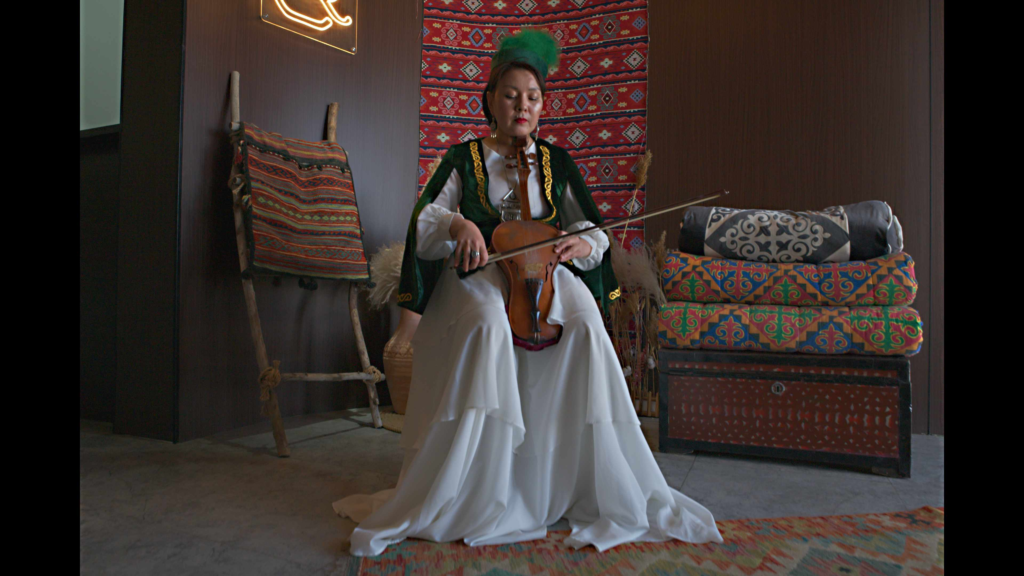
Dana photograph/video still: © Kristoffer Bübeck, Almaty, Kazakhstan, 2025.
Saz syrnai clay wind instruments. Photograph: Газиза Абзалова (17 December 2023), Wikimedia Commons, CC BY-SA 4.0. Resized for web; no crop.
Small dauylpaz, a Kazakh percussion instrument in the museum complex of S. Toraighyrov Pavlodar State University. Photograph dated 12 November 2012; photographer not identified. Uploaded by Dimash Kenesbek (DISEKenesbek), Wikimedia Commons, CC BY-SA 4.0. Resized for web; no crop.
Leave a Reply