
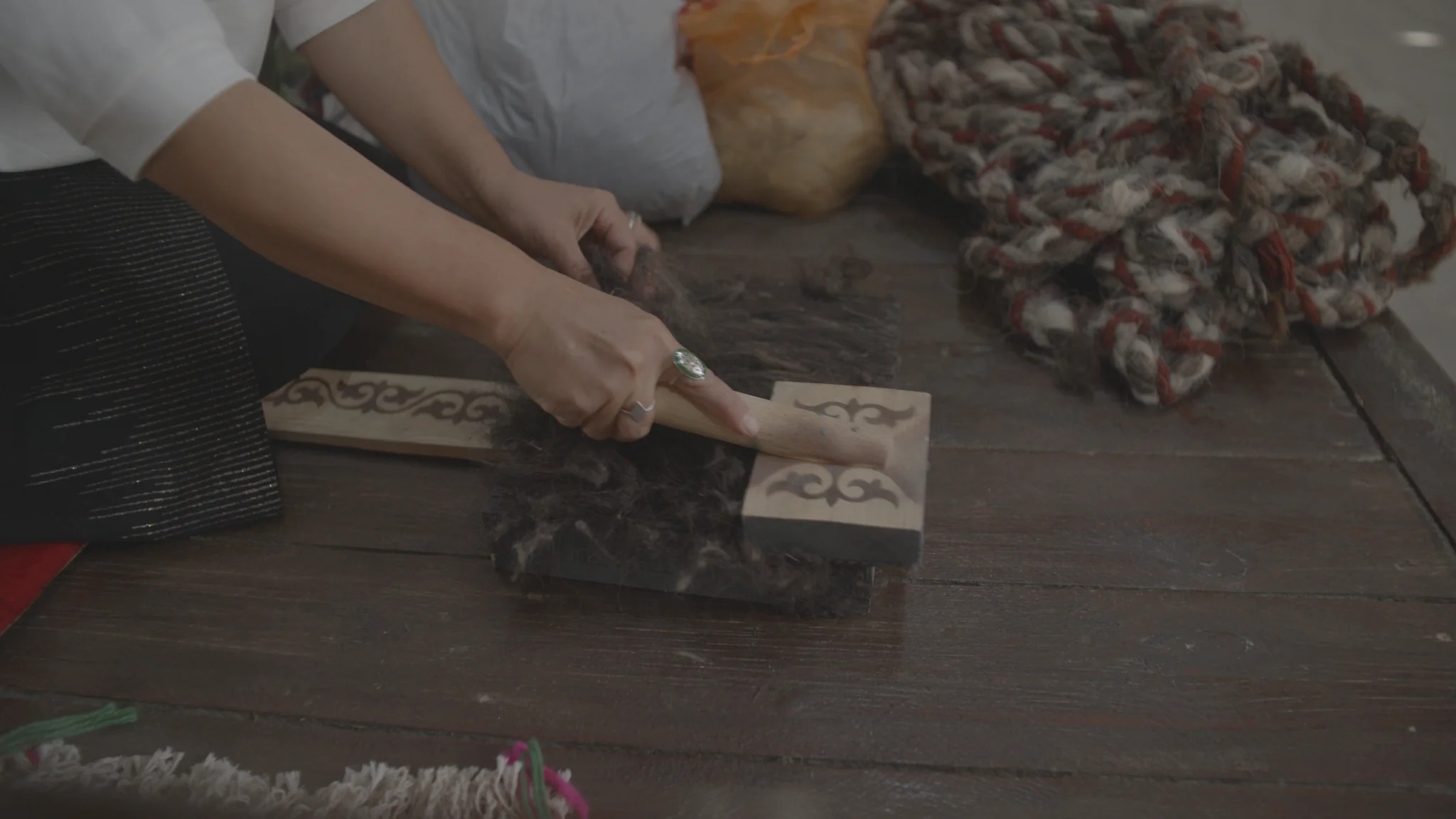
Caption: Makpal Beisenbayeva preparing wool with hand carders
Photo: Kristoffer Bübeck, Turkistan, Kazakhstan, 2025
ATLAS & NATION STORIES
Kazakh Ornament: The Visual Language of Kazakhstan
In this story
Kazakh ornament is not quiet.
It curls, repeats and mirrors. It appears on felt carpets, embroidered wall hangings, silver jewellery, carved objects, clothing and contemporary design. At first glance, these patterns may seem decorative. Look longer, and another story begins to emerge.
The curves have names. Their arrangement carries intention. Their meanings can connect to animals, landscapes, social life, hopes or beliefs, though those interpretations are not always fixed.
A line becomes a horn.
A horn becomes a repeated rhythm.
A border draws the eye around a carpet.
A textile helps turn a portable shelter into a home.
Researchers have described Kazakh ornament as a form of visual and non-verbal communication. Shara Mazhitayeva and colleagues, for example, discuss named ornamental forms and their historical interpretations, while noting that meanings have changed and some are no longer fully remembered (Mazhitayeva et al., 2015).
For travellers interested in fashion, textiles, jewellery and visual culture, that is an invitation to look beyond the beautiful surface. What is this object? Who made it? Where does it belong? Why does its pattern take this form?
A visual vocabulary shaped by everyday life
In traditional Kazakh life, textiles and decorative objects had practical work to do. Felt insulated a dwelling. Carpets shaped a room. Bags and chests stored possessions. Clothing, jewellery, leatherwork and carved wooden objects could carry ornament while serving everyday or ceremonial purposes.
That relationship between usefulness and visual expression matters. Kazakh applied arts are not best understood as paintings transferred onto objects after the fact. Material, construction, use and decoration often developed together.
An embroidered wall hanging occupied a particular place in a home. A patterned band might help secure or dress a yurt interior. A metal ornament moved with the body. Each offered a different surface, scale and making process — and changed how a motif could be seen.
Rather than look for one single ‘Kazakh pattern’, it is more useful to recognise a broad vocabulary of forms and approaches.
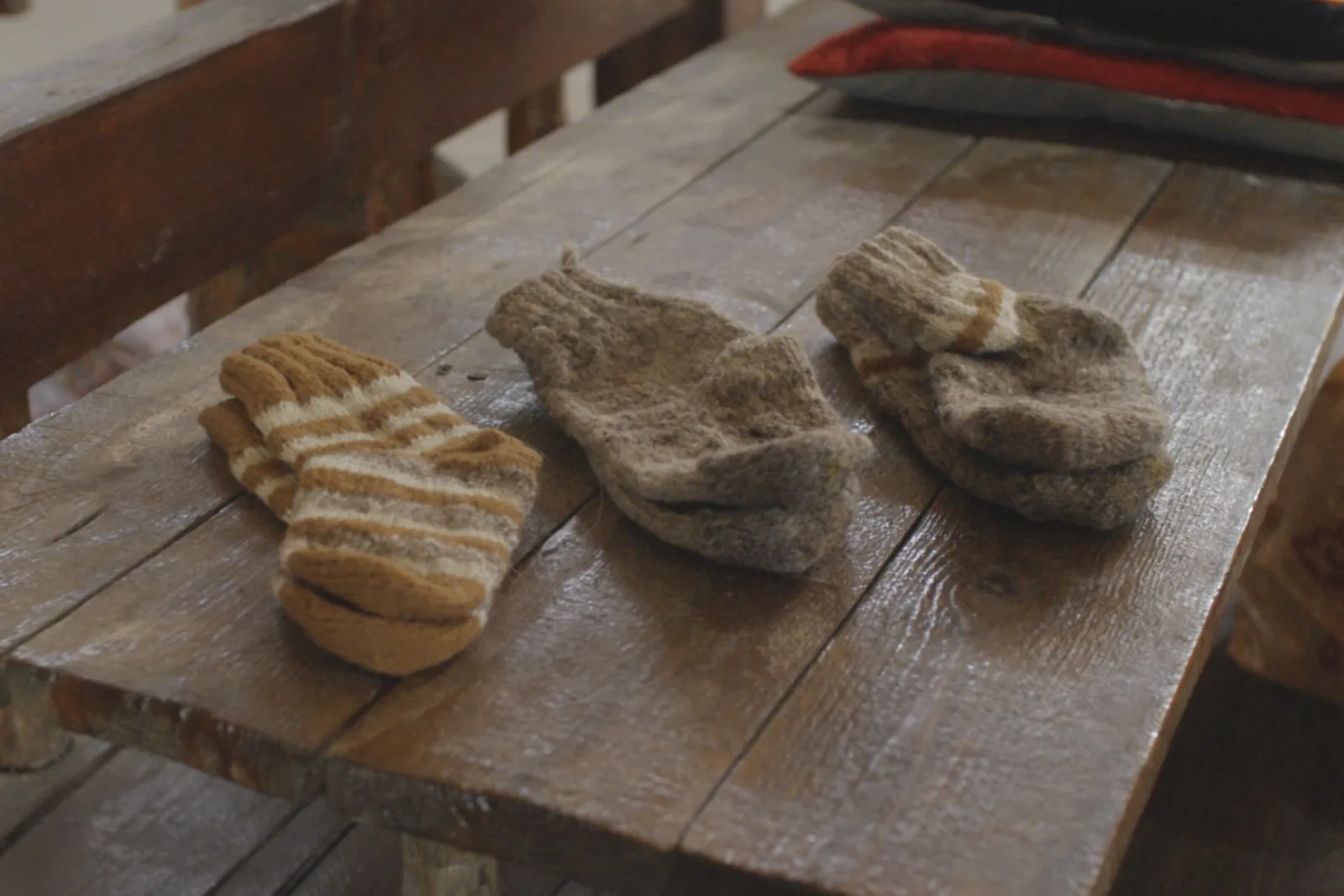
Caption: Makpal Beisenbayeva, handmade socks
Photo: Kristoffer Bübeck, Turkistan, Kazakhstan, 2025
Animals, plants, sky and geometry
Studies of Kazakh ornamental traditions describe families of animal-related, plant-related, geometric and celestial forms. These categories can help a new observer begin, but they are not a rigid classification for every object.
An animal may appear through the curve of a horn, the suggestion of a hoof or a stylised wing. Plant forms can become scrolling tendrils or floral embroidery. Repeated diamonds, circles and borders can organise a surface through symmetry and contrast.
Look for the relationship between figure and ground. What happens when the motif is reversed, mirrored or repeated? Does the border contain the composition or make it feel as though it might continue beyond the textile?
Such questions are useful even before the precise name of a motif is known. They move observation from ‘I like this pattern’ towards understanding how it is constructed.
The ram’s horn: a form that keeps returning
One of the best-known motifs is qoshqar müiiz, often transliterated koshkar muyiz — the ram’s horn. Related horn-shaped ornamental forms occur across felt work and other decorative arts. The scholarship of both Mazhitayeva and Sergali Suraganov discusses the motif’s central place in Kazakh ornamental practice (Mazhitayeva et al., 2015; Suraganov, 2021).
Its visual power lies partly in its adaptability. A curve can turn inward, stretch outward, appear in pairs or become part of a much larger symmetrical pattern. At a distance, the whole composition catches the eye; close up, individual elements become visible.
Historical writings associate ram’s-horn motifs with ideas including wealth and fertility. That is a documented interpretation, not a rule that applies identically to every maker, carpet, region or period.
Felt: pattern made through material
To understand ornament, it helps to understand the material carrying it. Felt has been important in Kazakhstan and elsewhere in Central Asia because wool can be turned into warm, flexible, durable surfaces suited to movable homes and domestic life.
A tekemet commonly brings coloured wool into the felt-making process, producing patterns whose transitions may be softly integrated with the material. A syrmak is commonly associated with contrasting pieces of felt assembled or appliquéd into more sharply defined ornamental designs (Zhukenova et al., 2016). Construction and terminology vary between makers and regions.
What these approaches share is a close relationship between pattern and making. A shape does not simply sit on the material. The material helps determine its edges, rhythm, thickness and scale.
Inside a yurt, such textiles could form part of floors and walls, alongside woven bands, bedding and other furnishings. They were not merely objects placed inside architecture; they helped make the interior comfortable, recognisable and inhabited.
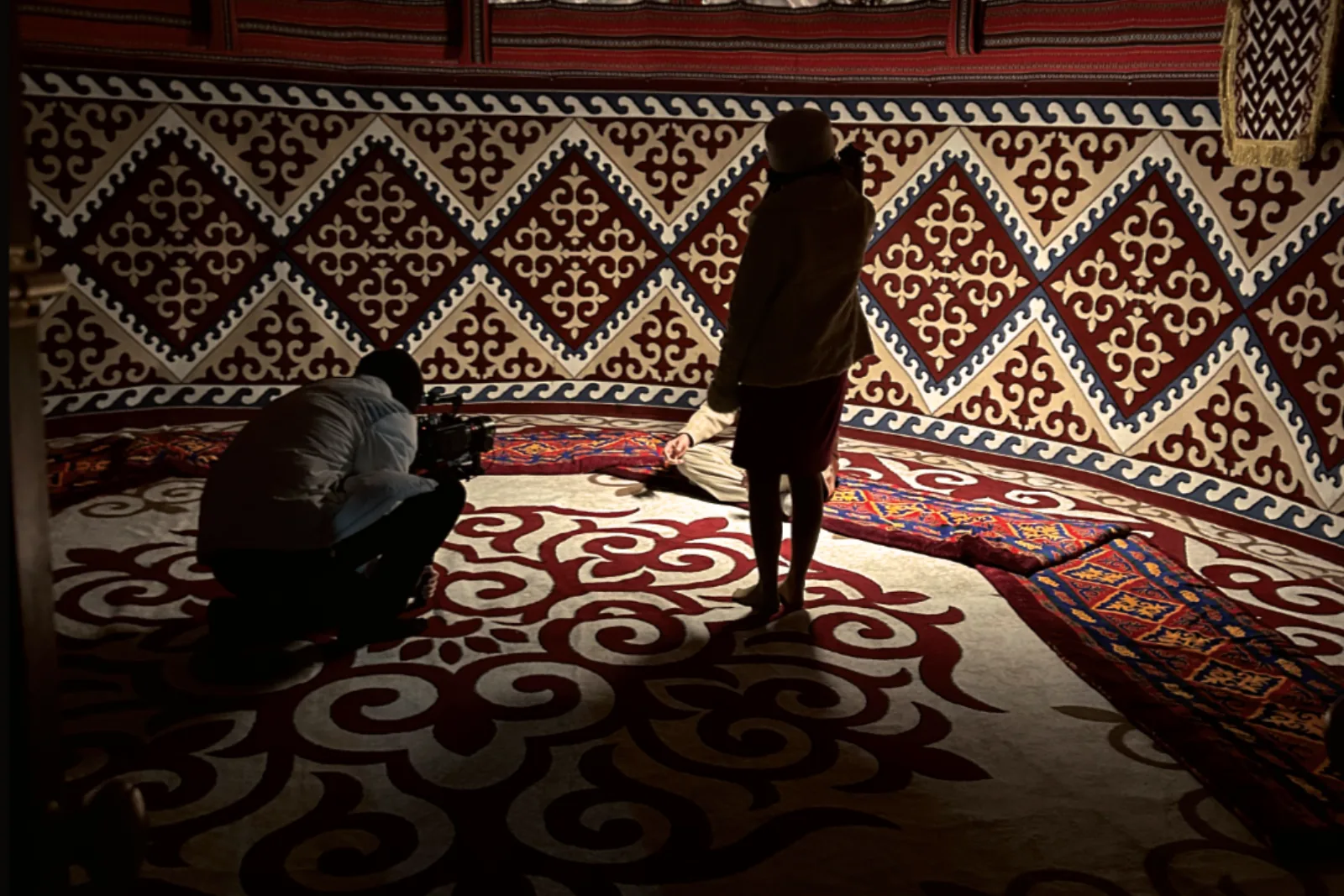
Caption: Gaukharbek Kunkhozhayev’s yurt, Turkistan
Photo: Kristoffer Bübeck, Turkistan, Kazakhstan, 2025
Tus kiiz: when a textile holds memory
Some of the most intimate examples of ornamental work are embroidered wall hangings, often known as tus kiiz. In her account of Kazakh communities in western Mongolia, anthropologist Anna Portisch describes densely embroidered hangings used in yurt and domestic interiors, among other textiles made by women (Portisch, 2009).
These works can be intensely personal. Names, dates, colours, borders and compositional choices may situate a textile within the life of a household. A wall hanging can be understood as skilled craft, visual expression and a record of people and place.
Look closely at its construction: a patterned wall hanging may be embroidered, woven, appliquéd or printed.
Jewellery and objects: ornament beyond fabric
Kazakh ornament is not limited to the soft surfaces of wool and cloth. Decorative forms also appear in silver jewellery, belts, carved wood, leather and other functional or ceremonial objects.
A bracelet or pendant changes the scale of a motif. The curve of a design must meet the form of the body and the properties of metal. Carving, engraving, stamping and other methods create different kinds of depth and contrast from embroidery or cut felt.
Looking across these materials helps reveal that ornament is not one technique. It is a field of choices — about surface, edge, proportion, repetition and what an object is meant to do.
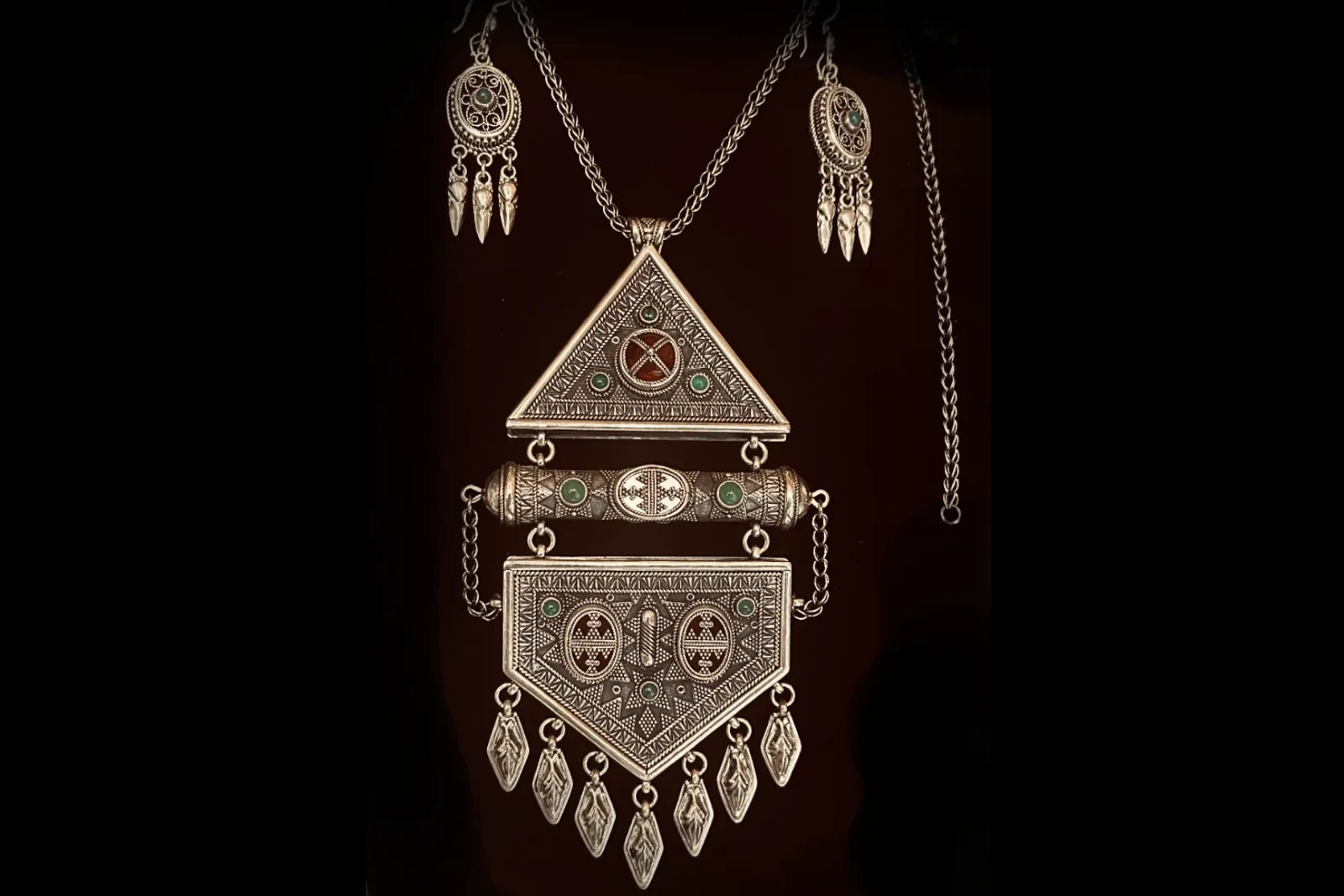
Caption: Berik Alibai House Museum
Photo: Kristoffer Bübeck, Astana, Kazakhstan, 2025
Colour and interpretation
Colour can carry associations in Kazakh cultural life, and researchers have examined relationships between colours, language and cultural understanding (Sarmanbetova and Mandal, 2019). Yet a blanket statement such as ‘red always means life’ or ‘black always means death’ would be misleading.
Colour meanings can change with context. They can also be practical, shaped by available materials, dyes, contrast, personal preference and the conventions of a particular craft.
For designers studying an object, it is useful to begin with what can be observed: which colours dominate, where they meet, whether a light shape sits on a dark ground and how contrast makes a motif legible. Cultural interpretation can follow, with evidence and care.
Contemporary Kazakh design: a living conversation
Ornament has not stopped at the museum door. Contemporary makers continue to work with felt, embroidery, jewellery, dress and related traditions, sometimes preserving established forms and sometimes transforming them.
A familiar curve might be enlarged, simplified, moved onto a new material or brought into a contemporary silhouette. That raises interesting design questions. Which qualities are important to retain? What happens when an object changes purpose? At what point does adaptation become detached from the source that gives it meaning?
The Smithsonian-linked publication Kazakhstan’s Crafts and Creative Economy documents a wide field of research and contemporary craft activity, rather than presenting Kazakh craft as a closed historical subject (Taylor and Shalabayeva, eds., 2020).
But the most valuable perspective is often the maker’s own. When looking at an object, ask how it was made and why its form matters to the person who made it.
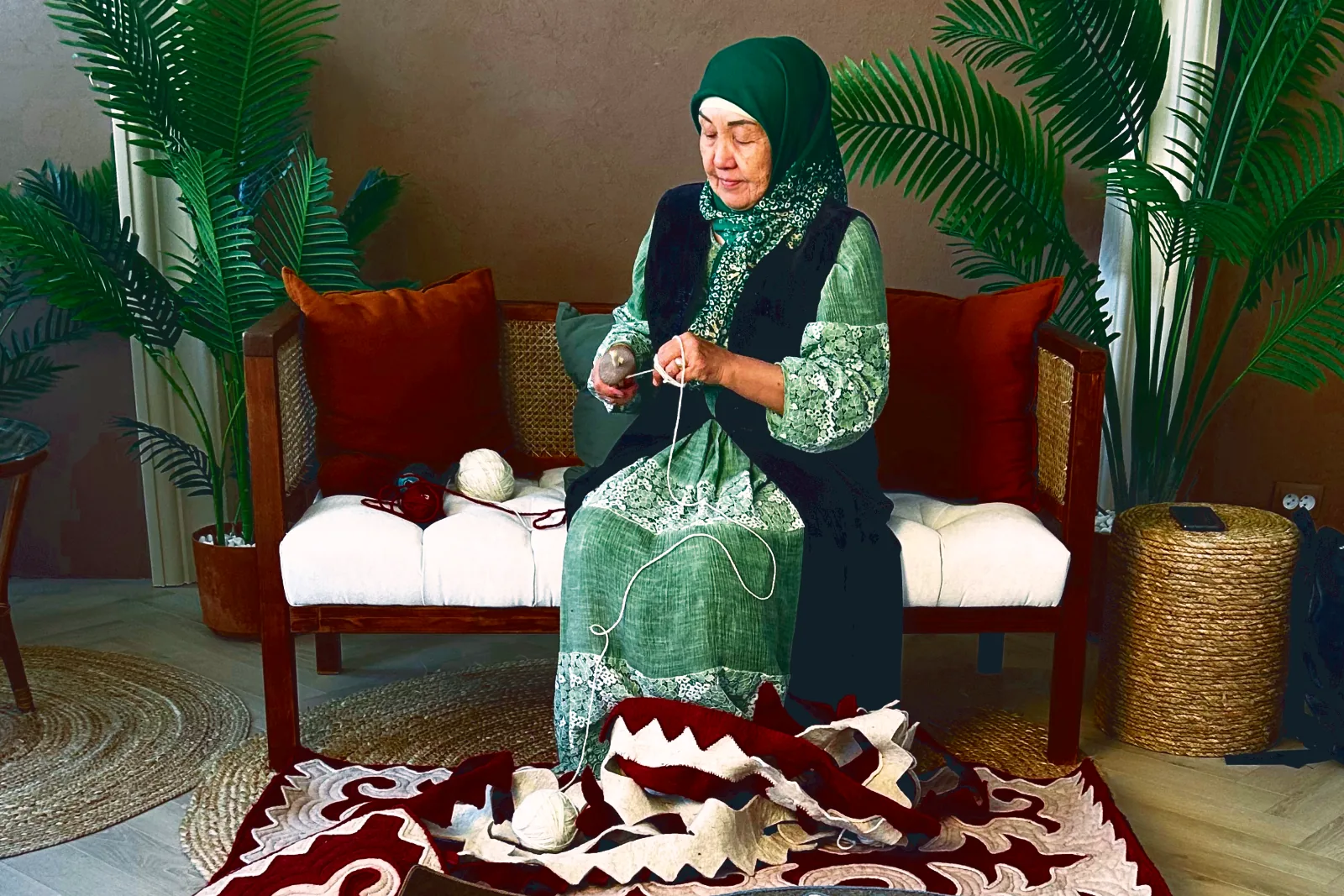
Caption: Keneshbubu Zhumaeva, felt master
Photo: Kristoffer Bübeck, Almaty, Kazakhstan, 2025
How to look more closely
A useful way to experience Kazakh ornament is to slow down and study one object rather than collect dozens of patterns as anonymous inspiration.
Start with the whole: what is the object, where would it be used, and what are its main materials?
Then study its structure. Where is the centre? What happens at the edge? Which forms repeat or mirror? How are colours and textures related? What changes when the surface is viewed from the other side of the room?
Finally, ask about authorship and context. Can the maker be identified? Where did the object come from? What does its name mean? Has the pattern’s meaning been explained by someone with relevant knowledge, or have we only guessed from its shape?
A sketch, photograph and a few careful notes can turn a first impression into deeper visual research. Permission and attribution matter, particularly when images or designs will be published or used in new work.
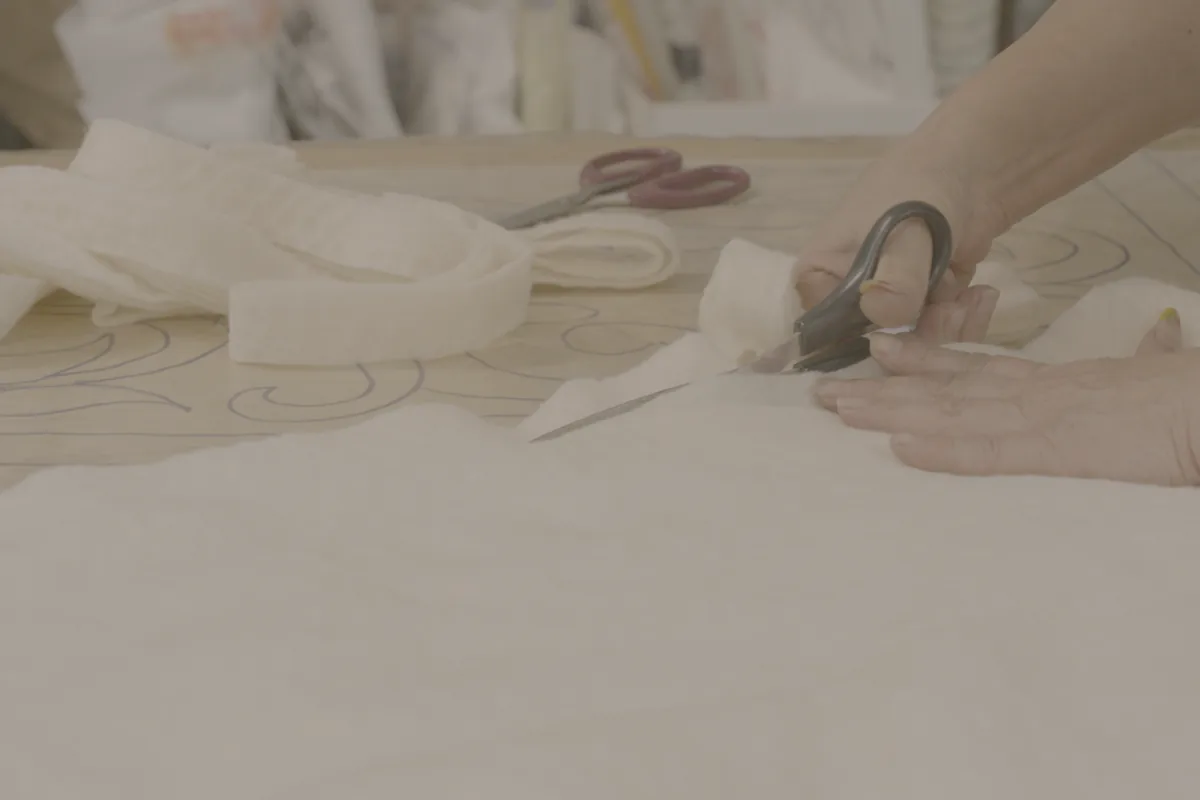
Caption: Kamilya Suleimenova – Design Studio
Photo: Kristoffer Bübeck, Astana, Kazakhstan, 2025
Looking for craft and design in Almaty
Almaty offers opportunities to look at both historic material culture and contemporary creative practice through museums, exhibitions, studios, shops and encounters with makers.
For anyone interested in textiles, jewellery or design, the richest visits are often the ones that connect a finished object with its process: the way felt is prepared, an embroidered line is built up, or a metal detail is formed.
Availability varies. Always check museum exhibitions, studio access and photography rules before visiting. A conversation with a maker can be more useful than a photograph taken without context.
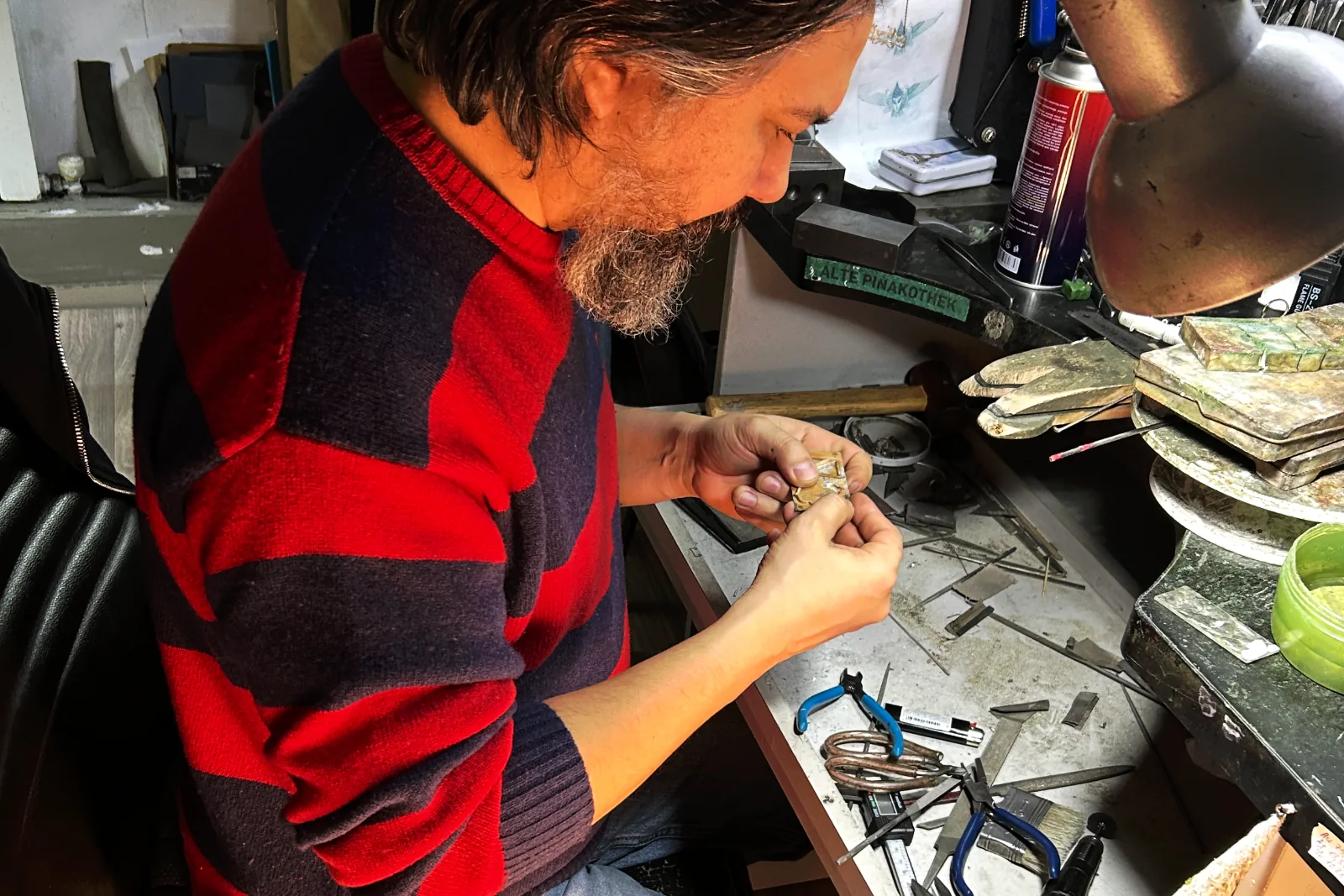
Caption: Nurdos Aliaskarov – Jewellery Designer
Photo: Kristoffer Bübeck, Almaty, Kazakhstan, 2025
Why it matters
A pattern can catch your eye in seconds. Understanding it may take much longer.
Kazakh ornament rewards that extra attention. It shows how form, material, daily life and cultural memory may meet in one object, and how a living craft practice can carry both continuity and change.
Look again at the horn inside the curve, the stitch inside the border, the decision behind a repeated form.
And, where possible, look for the maker behind the work.
EXPLORE KAZAKHSTAN THROUGH CRAFT AND DESIGN
Atlas & Nation is developing creative experiences in Almaty that bring visitors into contact with the people, materials and practices shaping Kazakhstan’s cultural landscape.
For fashion, textile, jewellery and design practitioners, encounters with local makers can provide context beyond the reference image — an opportunity to observe, ask questions and return to their own practice with new understanding.
Explore the Fashion, Textiles & Adornment Creative Intensive →
Resources and recommended reading
This list brings together the sources cited in the article and additional background reading consulted during its development. Individual studies reflect particular places, periods and authors’ interpretations.
Egizbayeva, M. and Zhumatayev, R. (2014) ‘Decorative and Applied Art of the Kazakhs Tarbagatai’, Procedia – Social and Behavioral Sciences, 122, pp. 236–239. doi: 10.1016/j.sbspro.2014.01.1334. Available at: Read the paper (PDF) (Accessed: 22 October 2026).
Kalshabayeva, B.K. and Sarmurzina, N. (2014) ‘Some Features of Decorative and Applied Arts of Kazakhs in Central Asia’, Procedia – Social and Behavioral Sciences, 122, pp. 110–113. doi: 10.1016/j.sbspro.2014.01.1311. Available at: Publisher’s article page (Accessed: 22 October 2026).
Kasenova, K.B. (2020) ‘Tracing cultural ties of carpet weaving in Kazakhstan and Central Asia’, Opción, 36, pp. 112–129. Available at: Publisher’s article page (Accessed: 22 October 2026).
Mazhitayeva, S., Kappasova, A.S., Kapanova, A.E., Kadyrov, Z.T., Myrzabayev, A.B. and Eskazinova, Z. (2015) ‘Semiology of Kazakh Ornaments’, Review of European Studies, 7(6), pp. 170–177. doi: 10.5539/res.v7n6p170. Available at: https://doi.org/10.5539/res.v7n6p170 (Accessed: 21 October 2026).
Mazhitayeva, S., Kadina, Z., Aitbaeva, B., Zhunusova, M. and Sateeva, B. (2016) ‘Appearance of Semiotics in Kazakh Mentality’, Man in India, 96(12), pp. 5575–5584. Available at: Read the paper (PDF) (Accessed: 22 October 2026).
Naurzbayeva, A. and Ibragimov, A. (2022) ‘Contemporary Kazakh Crafts in the Focus of Ethno-Symbolism: Methodological Aspects’, Central Asian Journal of Art Studies, 7(2), pp. 28–40. doi: 10.47940/cajas.v7i2.575. Available at: Read the journal issue (PDF; article begins on printed page 28) (Accessed: 22 October 2026).
Portisch, A. (2009) ‘The portrait: Kazakh embroidered wall hangings’, The Newsletter, 52 (Winter), p. 48. Available at: https://iias.asia/the-newsletter/article/kazakh-embroidered-wall-hangings (Accessed: 21 October 2026).
Sarmanbetova, U. and Mandal, R. (2019) ‘Symbolism and Semantics Colors in Kazakh Culture’, North American Academic Research, 2(4), pp. 101–115. Available at: Publisher’s April 2019 issue (Accessed: 22 October 2026).
Suraganov, S. (2021) ‘The leading ornamental motif koshkar muyiz in Kazakh ornamentation: in search of the primordi’, Turkic Studies Journal, 3(2), pp. 99–110. doi: 10.32523/2664-5157-2021-2-99-110. Available at: https://doi.org/10.32523/2664-5157-2021-2-99-110 (Accessed: 21 October 2026).
Taylor, P.M. and Shalabayeva, G. (eds.) (2020) Kazakhstan’s Crafts and Creative Economy: Proceedings of an International Symposium. Almaty: Kasteyev State Museum of Arts. Available at: https://profiles.si.edu/display/sro_156723 (Accessed: 21 October 2026).
Zhukenova, Z.D., Soltanbaeva, G.S. and Izhanov, B. (2016) ‘Traditional Felt in the Kazakhs Folk Art’, International Journal of Environmental & Science Education, 11(10), pp. 3719–3729. Available at: Read the paper (PDF) (Accessed: 22 October 2026).
Leave a Reply